Bernardo Zamora   ·   Mathematics & Physics Meets Art

Look behind the curtain!

For thousands of years, humans have tried to understand the rules that govern our universe, and created the 'language' and tools of mathematics to describe what we found. These formulas and algorithms, when given color, texture, and light, reveal beautiful patterns that are normally hidden from view.

Below are some of the images featured in an upcoming book. All are original, mathematically accurate renderings of equations that describe our universe. None were created using AI.

A visual journey through the mathematics that explains our universe!

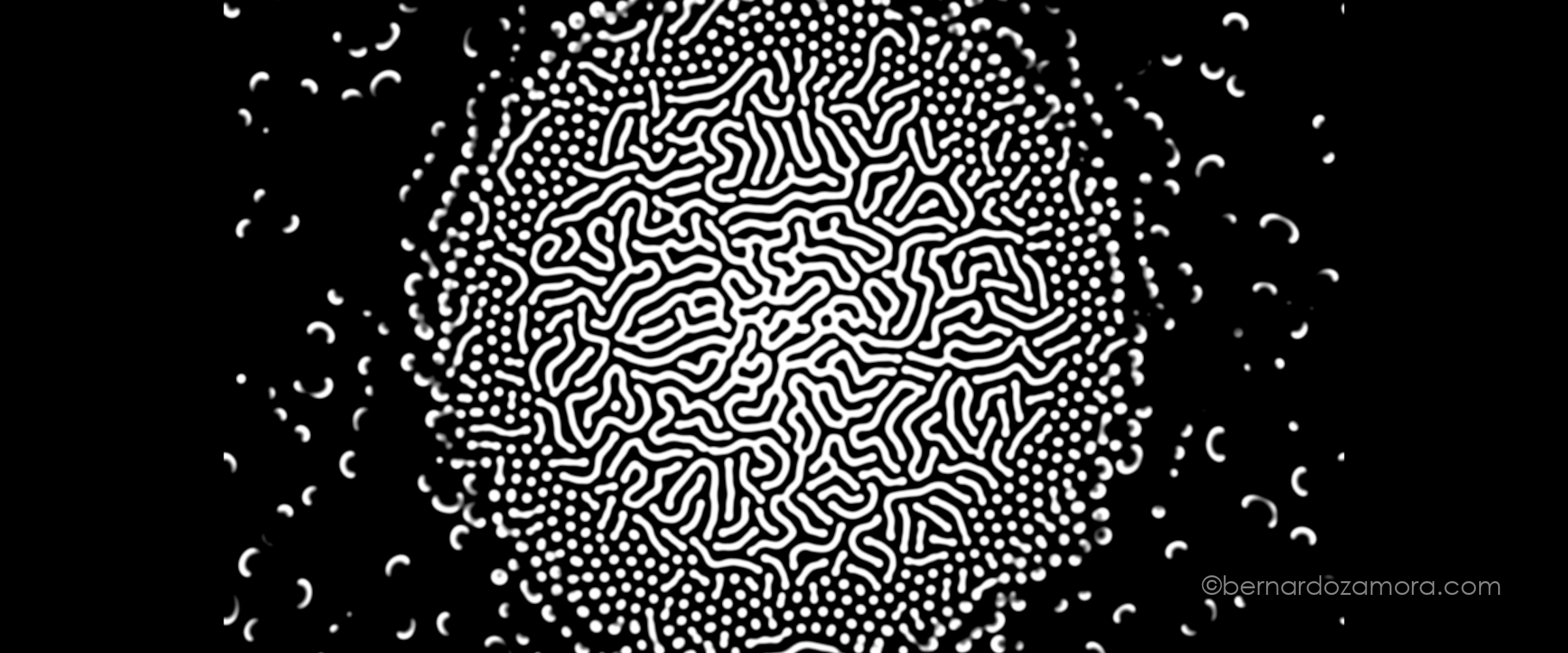
Intricate organic pattern generated by mixing two simulated chemicals
Gray-Scott reaction-diffusion: mixing two chemicals

Two chemicals of different concentrations react. As they diffuse, they produce these organic patterns, which are calculated using two partial differential equations.
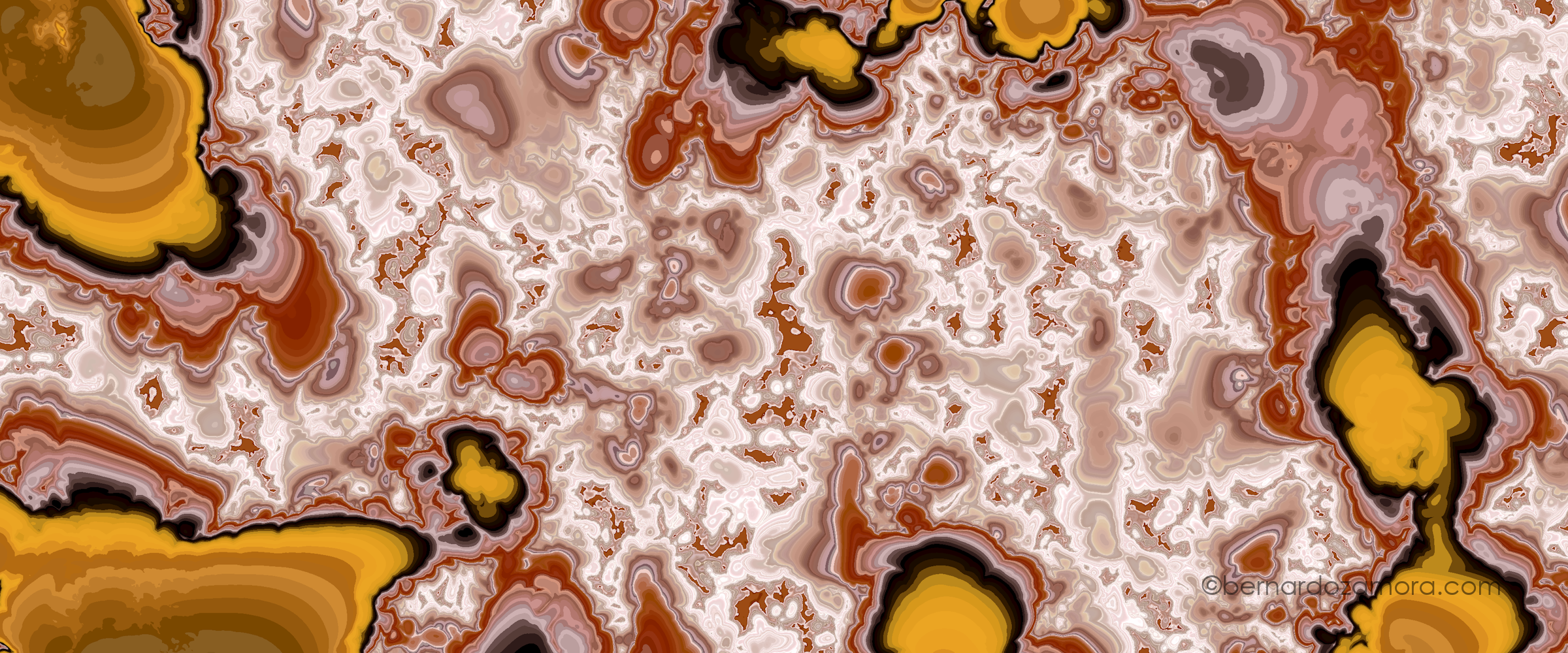
A natural-looking marble texture created with mathematical noise
Hybrid Fractional Brownian motion (fBM): marble patterns

Layering several levels of 'mathematical noise' creates natural-looking patterns resembling clouds or marble. This is calculated by summing noise at different amplitudes and frequencies.
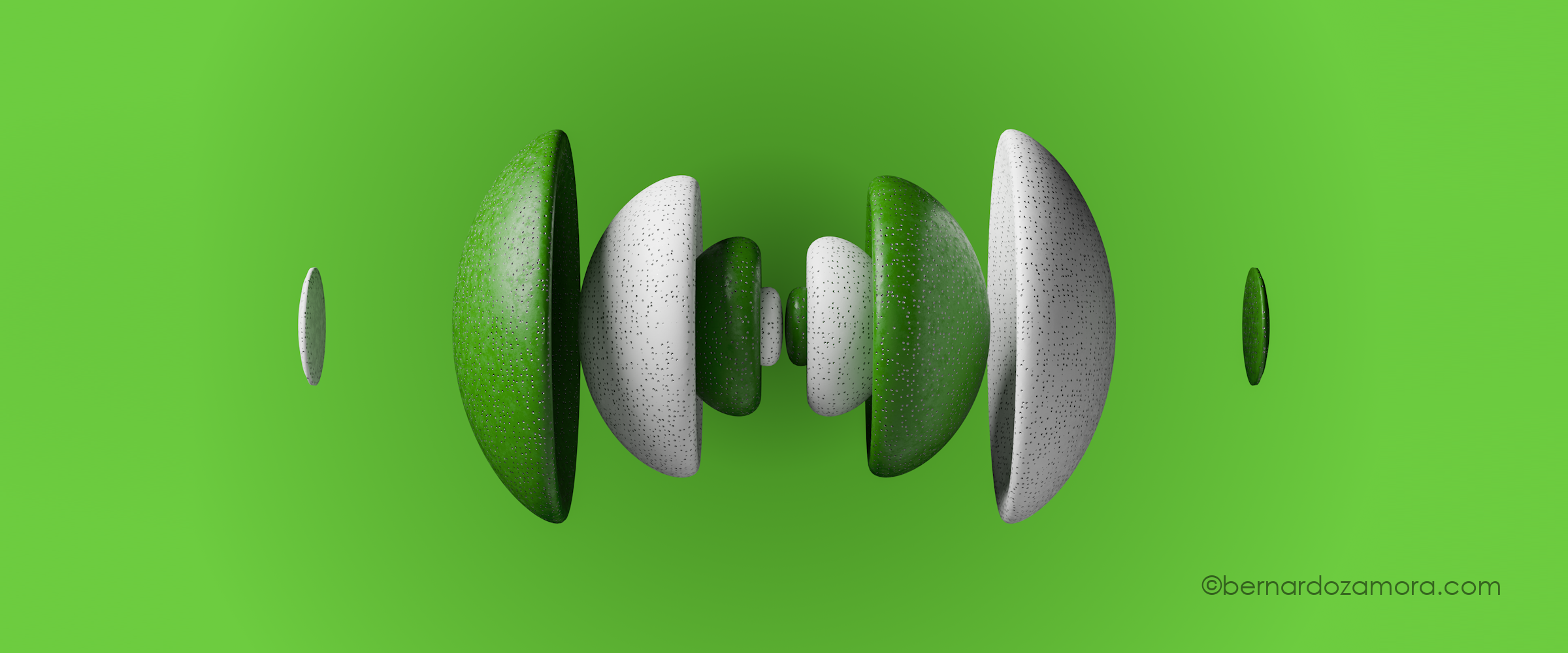
A 3D mathematical isosurface rendering of a hydrogen atom orbital on a bright lime-green background. The symmetrical, fragmented geometric structure features alternating nested hemispherical shells and discs in white and deep forest-green, aligned horizontally along a central axis.
Molecular Orbitals: Geometric Clouds of Probability

Electrons are three-dimensional wavefunctions defined by the Schrödinger equation. This isosurface shows a hydrogen orbital state, with colors representing the positive and negative mathematical phases.
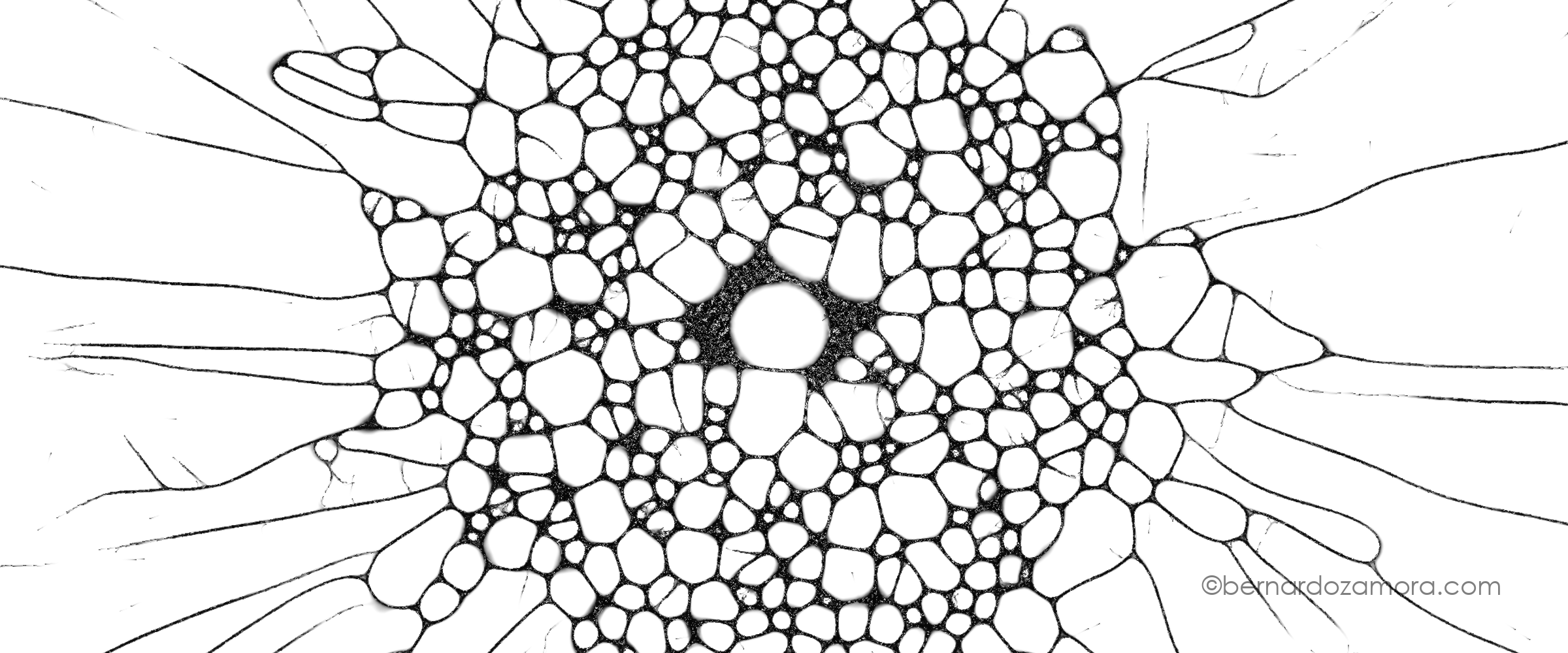
A high-contrast, black-and-white generative art simulation of a slime mold network. The pattern features a dense, central cluster of organic, bubble-like cellular compartments that transition into thin, delicate branching filaments radiating outward like a spider web against a stark white background.
Physarum Simulation: Emergent Intelligence

The brainless slime mold Physarum Polycephalum optimizes its path without central control. This plate simulates this behavior with custom parameters that define how particles follow simulated pheromone trails.
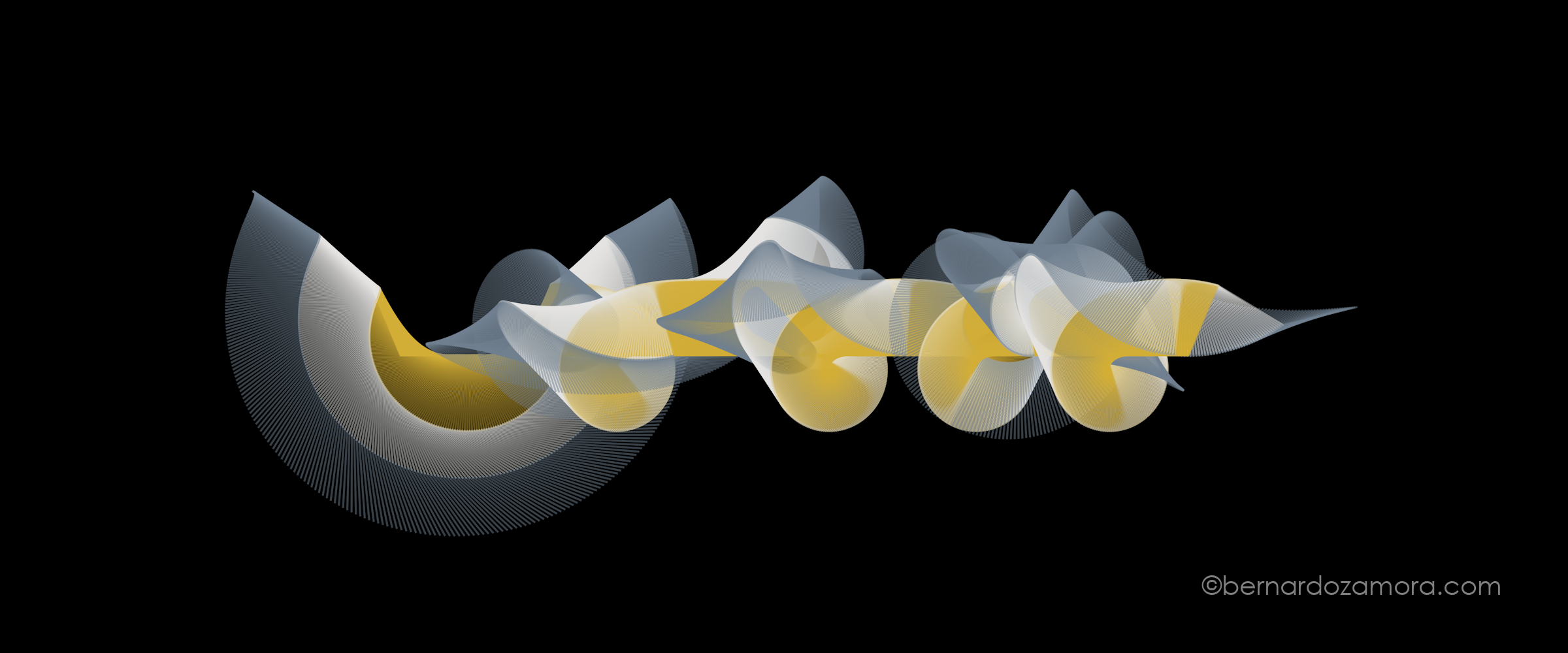
A triple pendulum chaotic path visualization on a black background. Overlapping, translucent ribbon-like trails in yellow, white, and blue-gray sweep across the center, drifting leftward like ghost traces.
The Triple Pendulum: Chaotic Wakes

A triple pendulum follows simple physical rules, yet with no friction its movement is completely chaotic. This simulation captures the wakes left behind a triple pendulum as it moves.
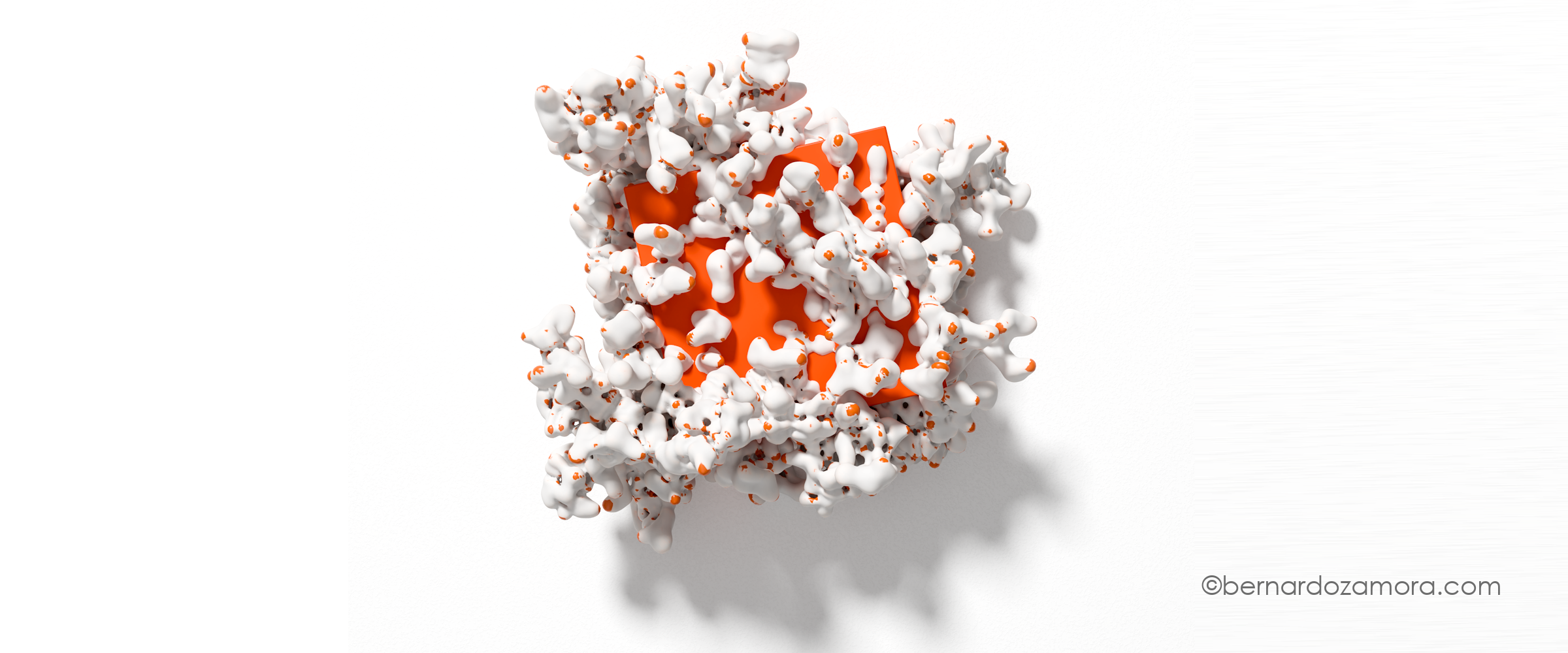
An orange, coral-like structures growing outwards from a central white box
Differential Growth: how living organisms grow

Coral, fungi and root growth are emulated with a technique where connected points pull toward their neighbors but push away from crowded areas, with new points sprouting wherever space opens up.
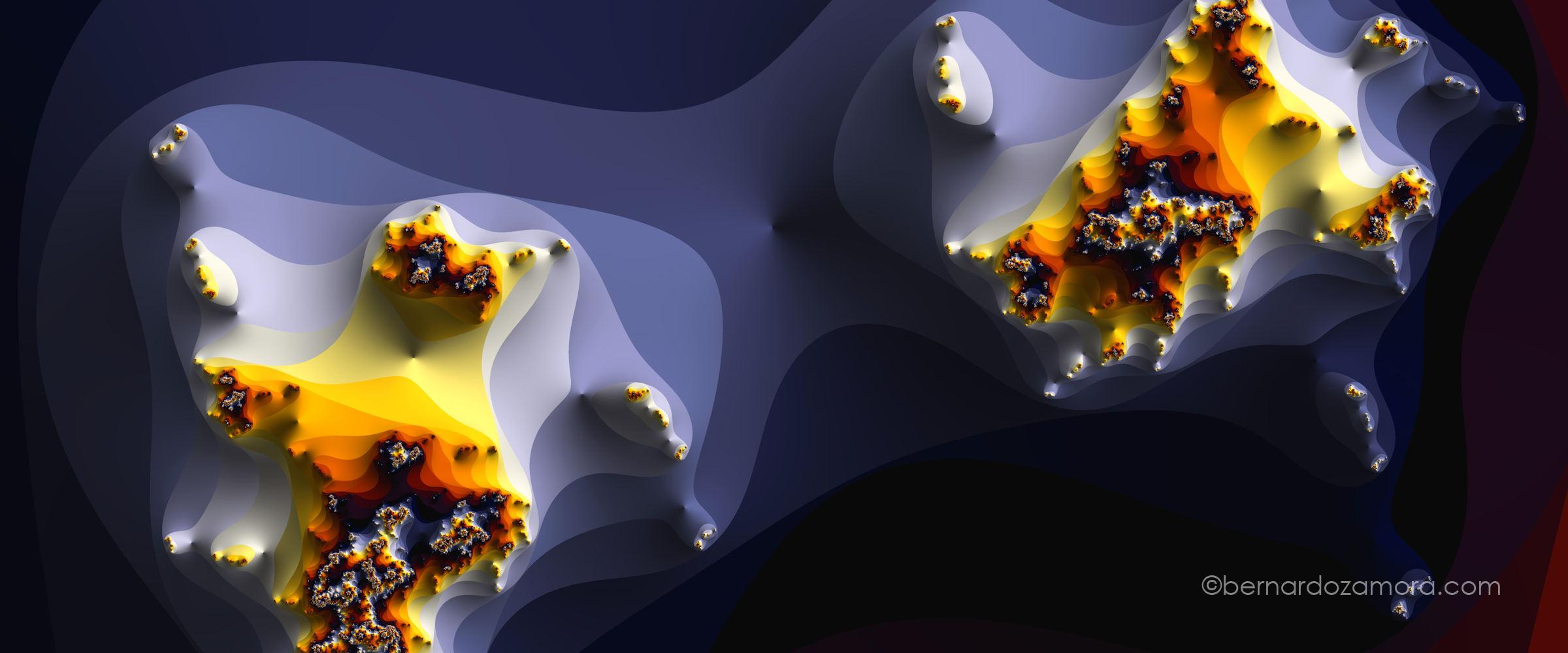
A high-resolution escape-time fractal known as a Manowar Julia set. The image features a dark navy and deep maroon background with a stylized, flowing, dual-lobed central figure. The internal boundary of the fractal is intricately detailed with a striped color palette that transitions sharply from deep black and dark orange to vibrant golden yellow and stark off-white, creating a layered, woven appearance.
Manowar Julia: Iterated Chaos

The Manowar Julia is an escape-time fractal born from simple, repeated feedback loops operating on complex numbers. The distinct striped palette charts the precise speed at which each coordinate escapes toward infinity.
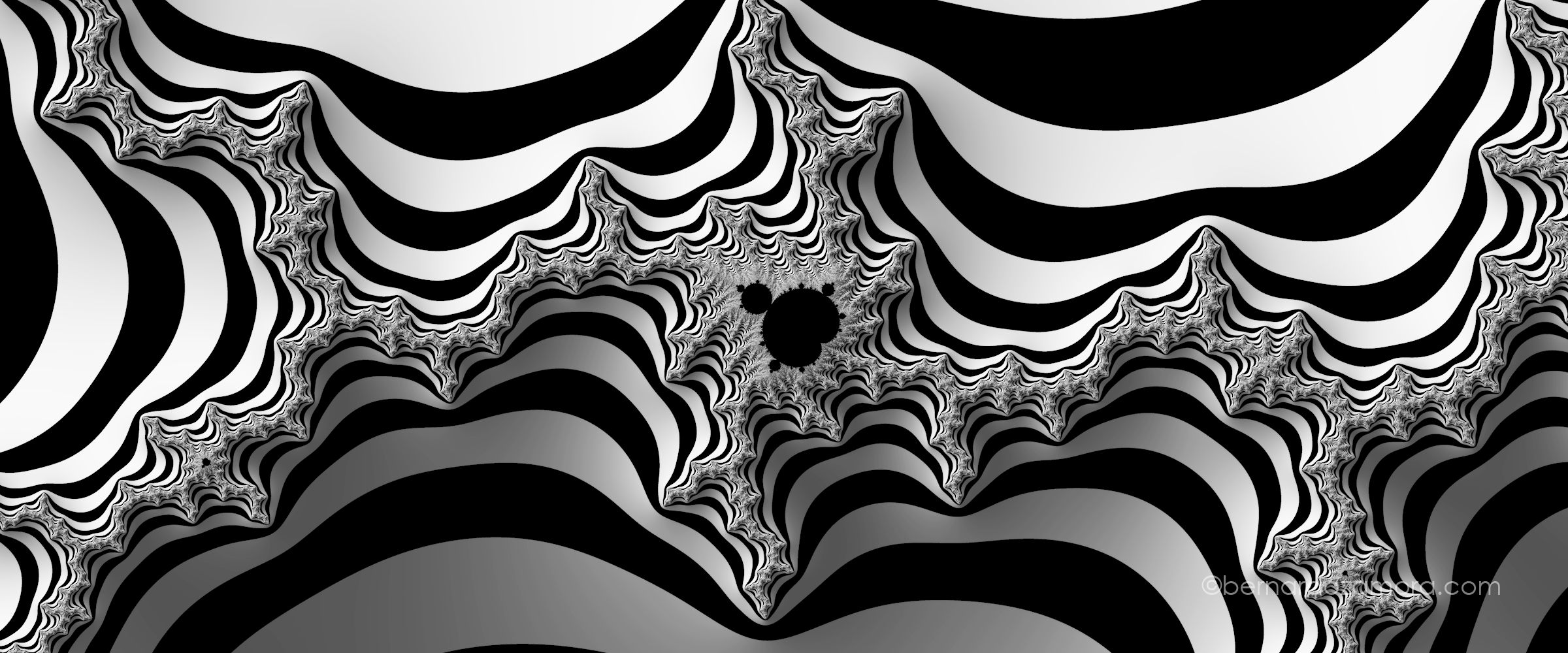
A high-resolution, monochrome zoom of the Mandelbrot set fractal. The image features a striking zebra-stripe aesthetic composed of alternating solid black and smooth, gradient-shaded white and gray undulating bars. A jagged, infinitely complex frontier waves horizontally across the center, revealing a microscopic, pitch-black cardioid silhouette of a mini Mandelbrot bulb nestled deep within the intricate, self-similar folds.
The Mandelbrot Set: infinite and never-repeating detail

The set consists of complex numbers whose value stays bounded when a specific formula is applied repeatedly. This image shows a section of this chaotic set, in black and white stripes.

Yellow background with a diagonal line, in rich yellow tones
Complex numbers: required to explain many natural processes

Visualizing equations with complex numbers require adding colors or showing only part of the result. This image plots the complex function (z+1i)/(z-1i) using 'Domain coloring'.
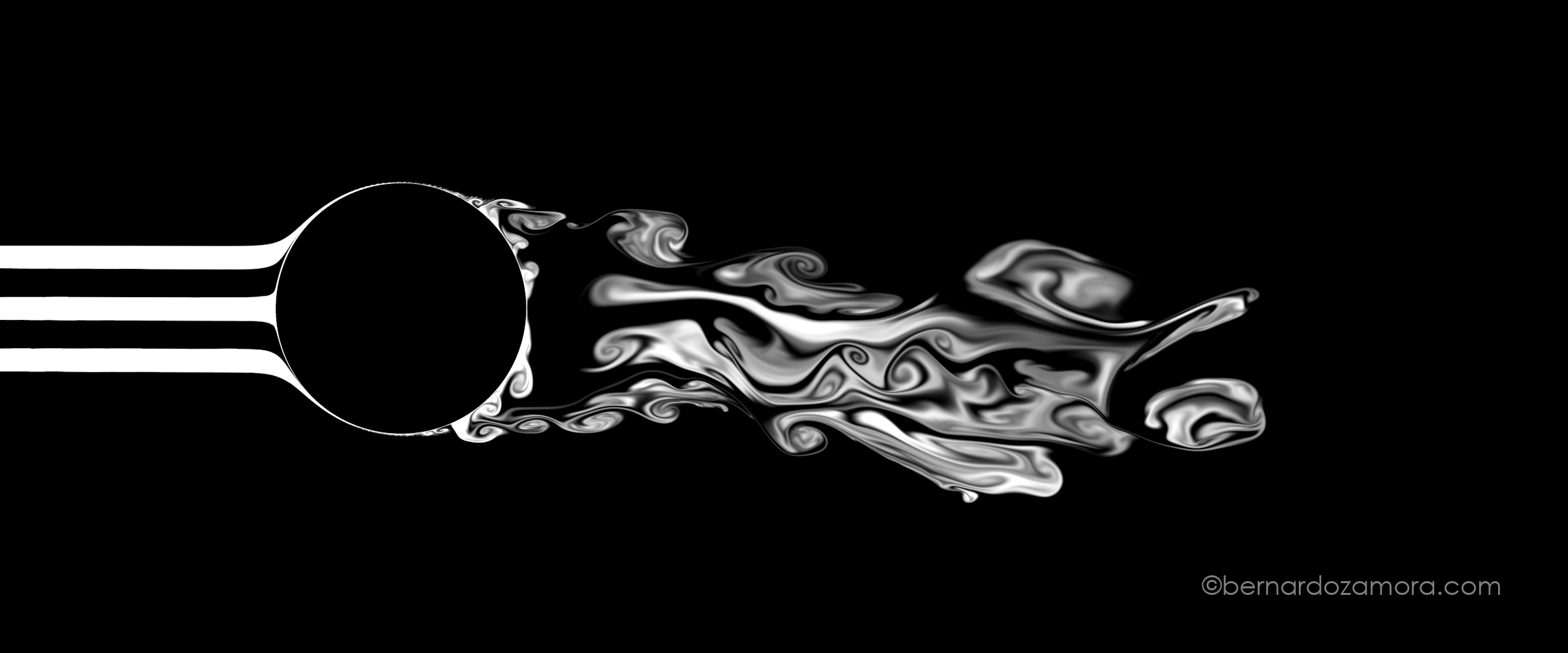
Swirling white gas currents moving against a stark black background
Navier-Stokes equations: simulating gas flows

When a gas moves past a solid object, it can result in a swirling turbulent pattern or a calmer 'laminar flow' depending on the speed and viscosity. This image is the result of 40 trillion calculations.
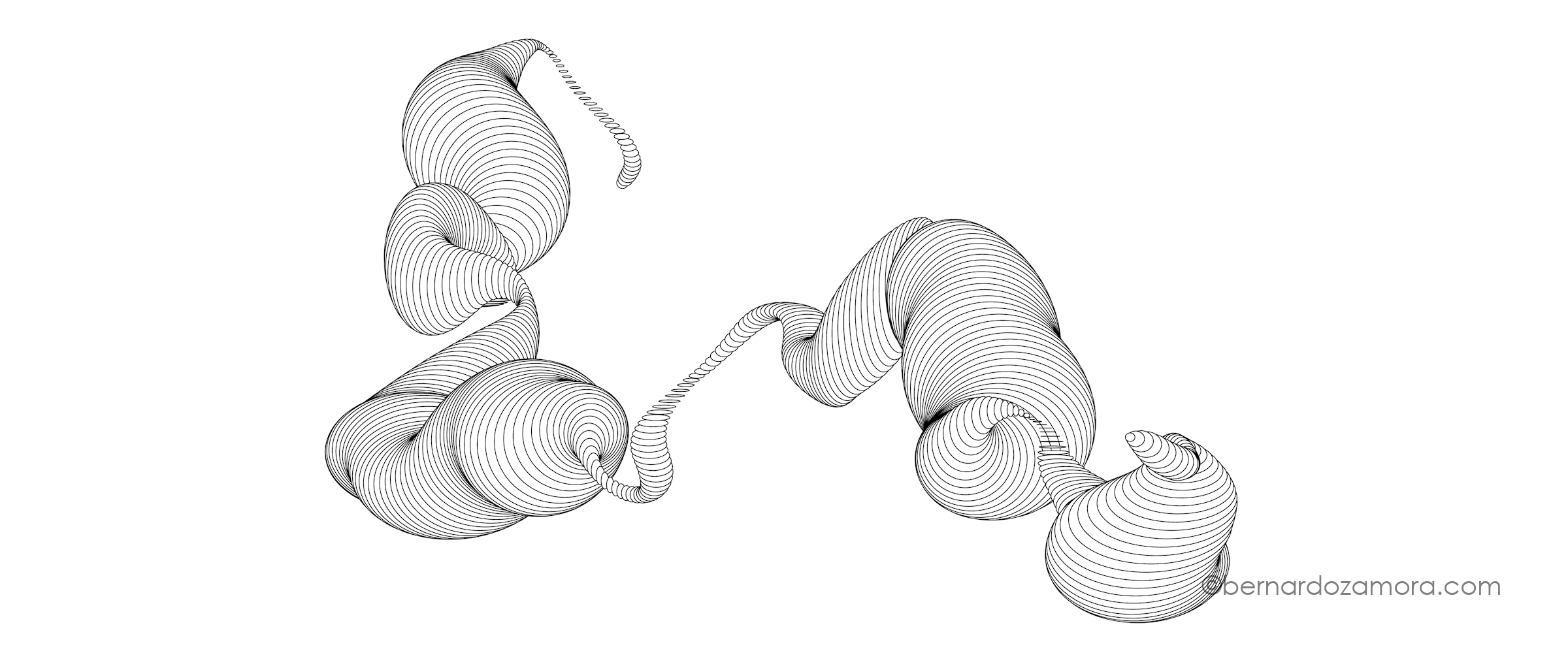
Smoothly undulating, organic landscape pattern generated by Perlin noise
Perlin Noise: generate randomness with memory

While complete randomness exists at the quantum level, nature frequently uses 'smooth' randomness, like the rolling contours of terrain. This organic flow is created using 'Perlin noise'.

Crystal Klein bottle with yellow liquid pouring in, with black background
Klein Bottle: A surface with no inside or outside

Described by Felix Klein in 1882, the Klein Bottle has no volume, and its true form exists in four dimensions. Rendered in crystal with amber liquid.
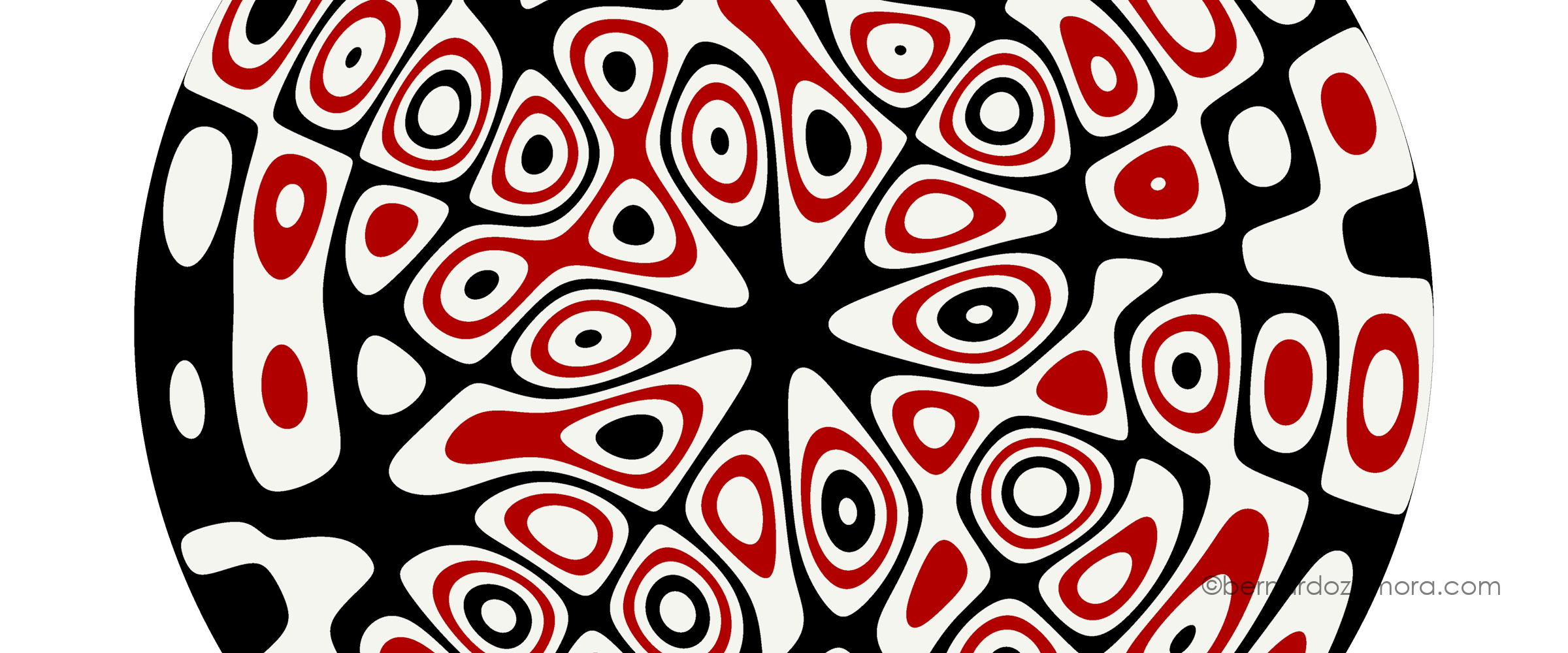
A digital render of a Chladni plate showing geometric vibration patterns in black, red, and white.
Chladni Plates: Sound waves made visible

When a metal plate is vibrated at a resonant frequency, it generates geometric Chladni patterns. This render of a Chladni plate is color-coded based on the vibration magnitude.
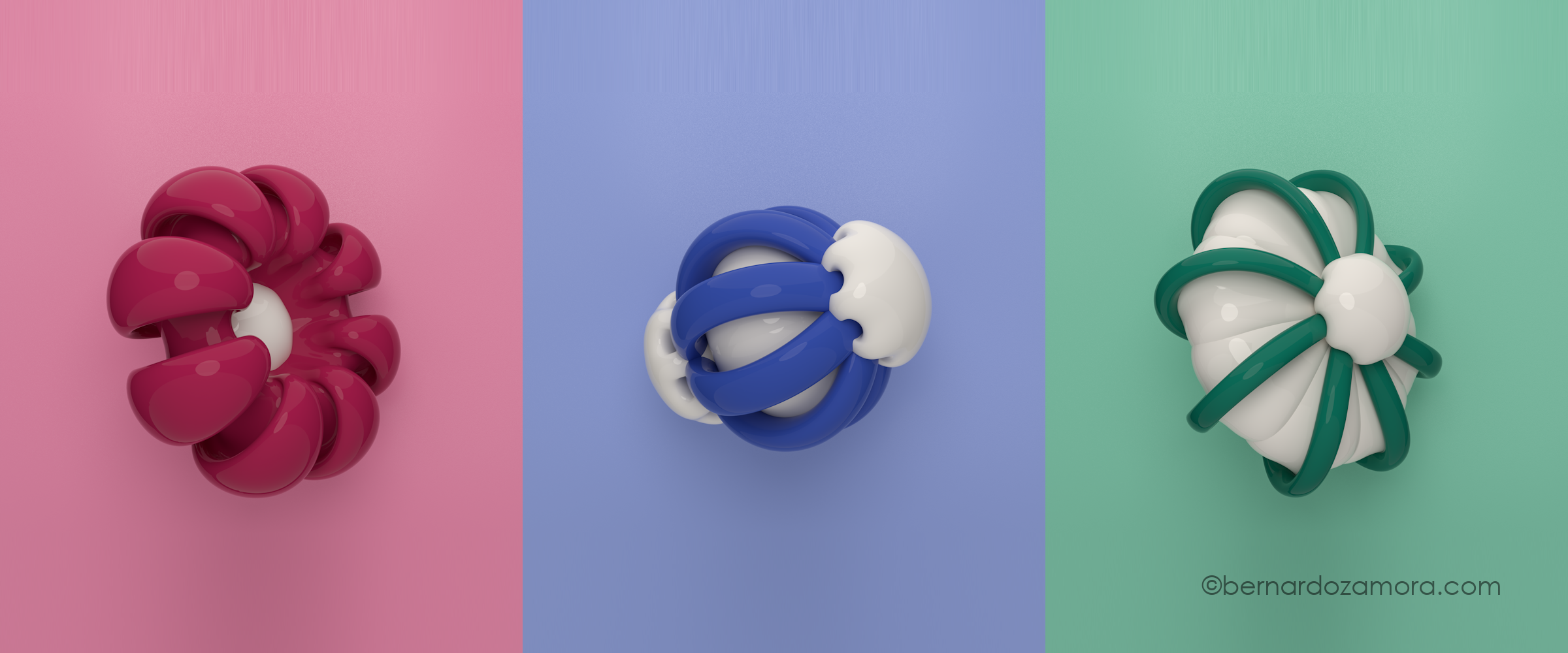
Three different colored sections
Sphere Eversion: Turning a sphere inside-out without creases or breaks

In topology, a sphere can be turned inside out without tearing, puncturing, or sharp creases. This piece captures three snapshots of that geometric transformation, showing different stages of this complex topological process.
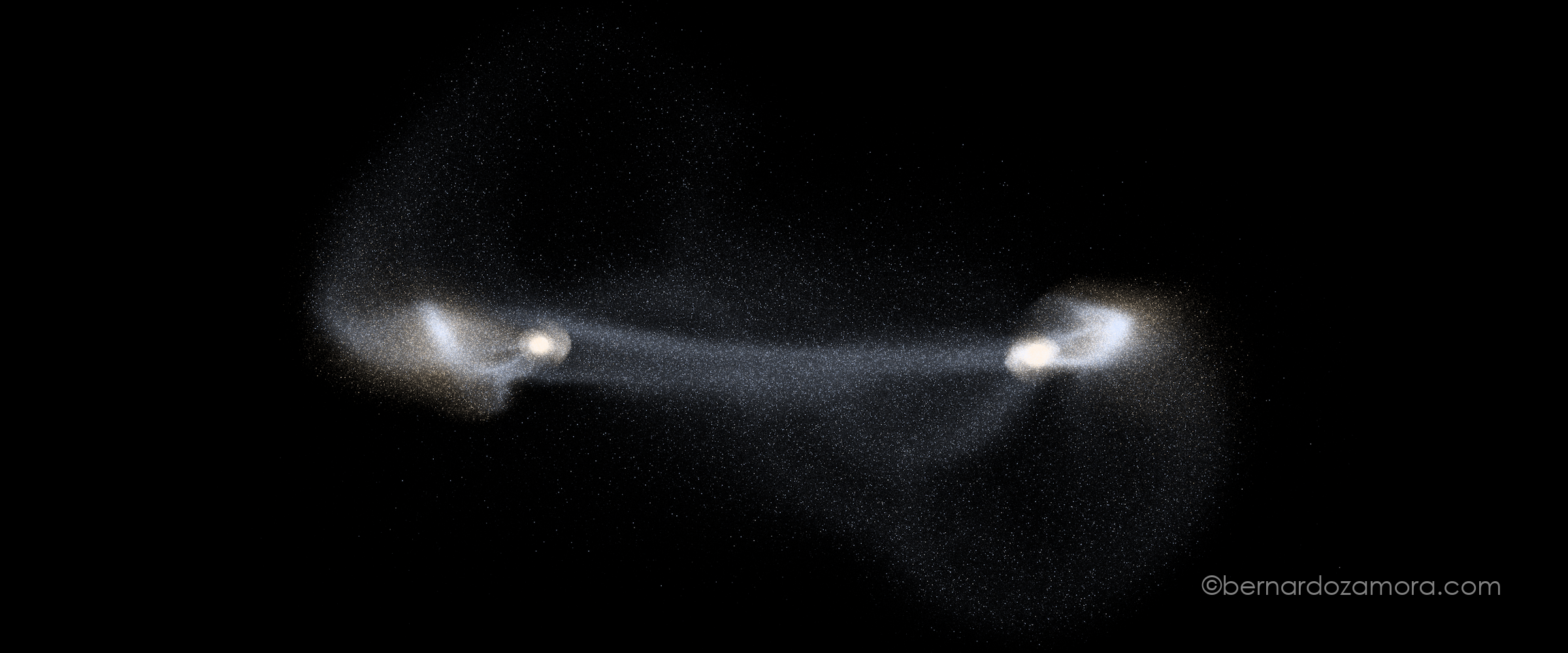
A detailed astrophoto-style simulation against deep black space, capturing 16 million stars in a cosmic dance during a close gravitational pass between the Milky Way and Andromeda galaxies. A bright bridge of starlight connects two distinct luminous galactic cores, with sweeping, asymmetric tidal streams of stellar dust curling outward into the dark.
Galaxies Colliding: Gravity Creates a Cosmic Dance

Our Milky Way and the Andromeda Galaxy are moving toward each other at ~246,000 mph. A possible outcome is a side-collision, and this simulation of 16 million stars shows their positions in 425 million years.
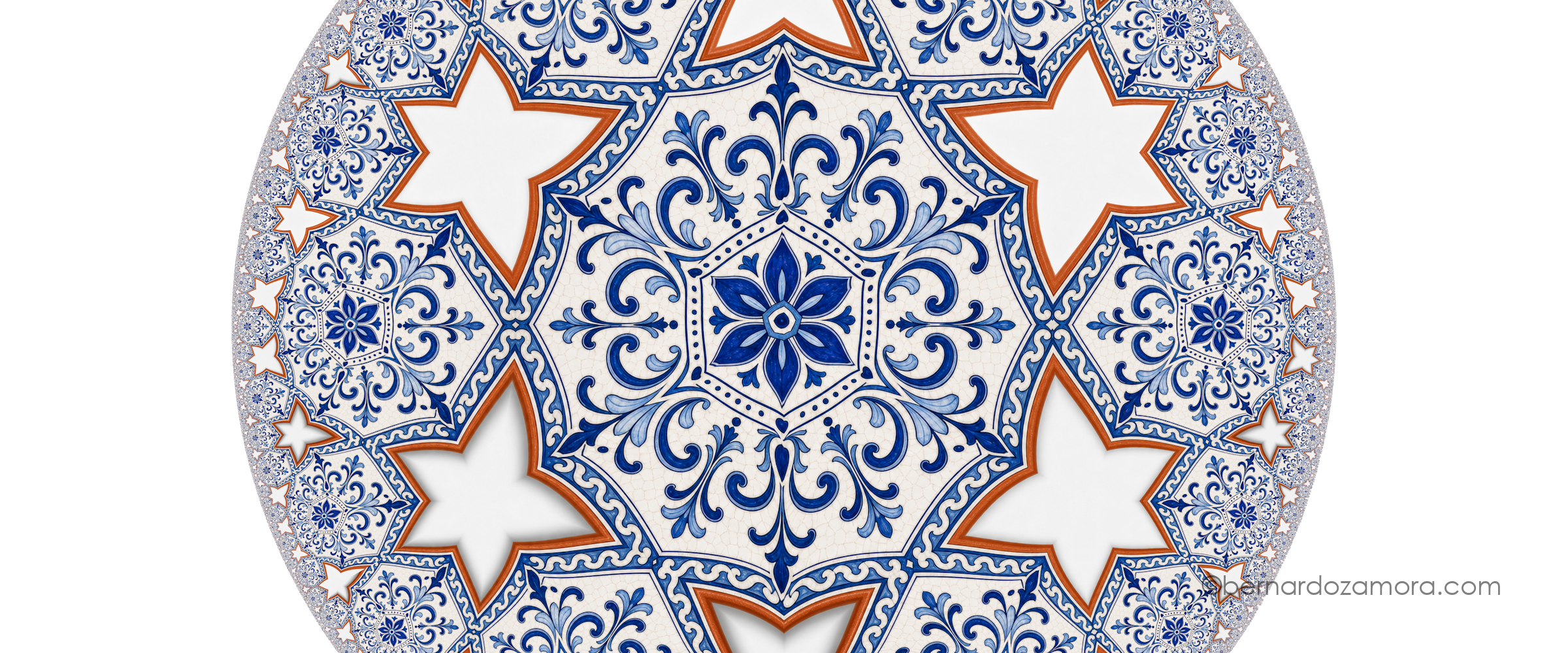
Image of hyperbolic tesselation, showing a set of Mexican talavera-looking tiles in white background.
Hyperbolic Tessellation: Filling a plane with a repeating shape

In hyperbolic geometry, a plane can infinitely be tiled with a repeating shape. This plate is based on an intricate, Mexican Talavera-style ceramic pattern, projected on a Poincaré disk.
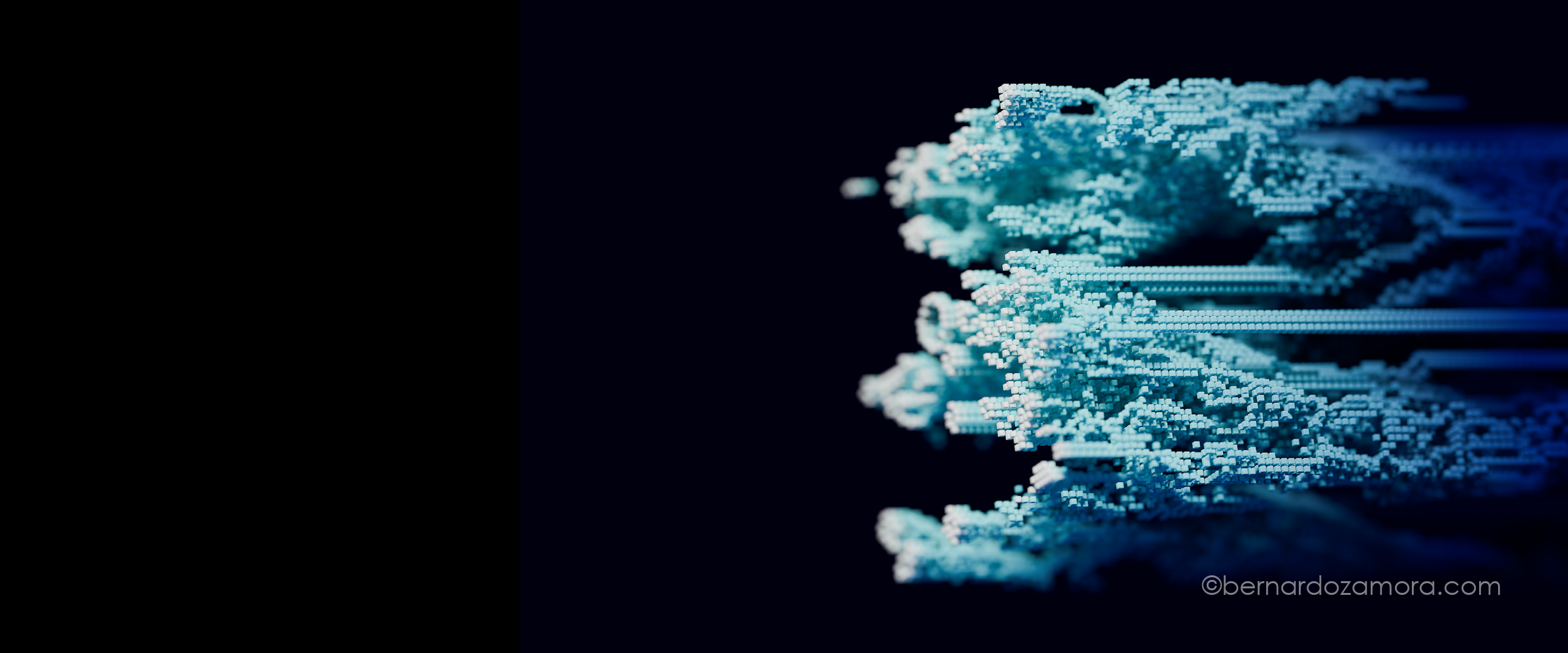
A 3D cellular automaton simulation based on Conway's Game of Life, showing an intricate, organic cluster of glowing light-blue voxels emerging and trailing toward the right against a black background.
Game of Life: Emergent complexity from simple rules

Conway's Game of Life uses just four simple local rules to generate complex, organic behavior. This image captures several of generations evolving over time, extruded into voxel-based 3D structure.
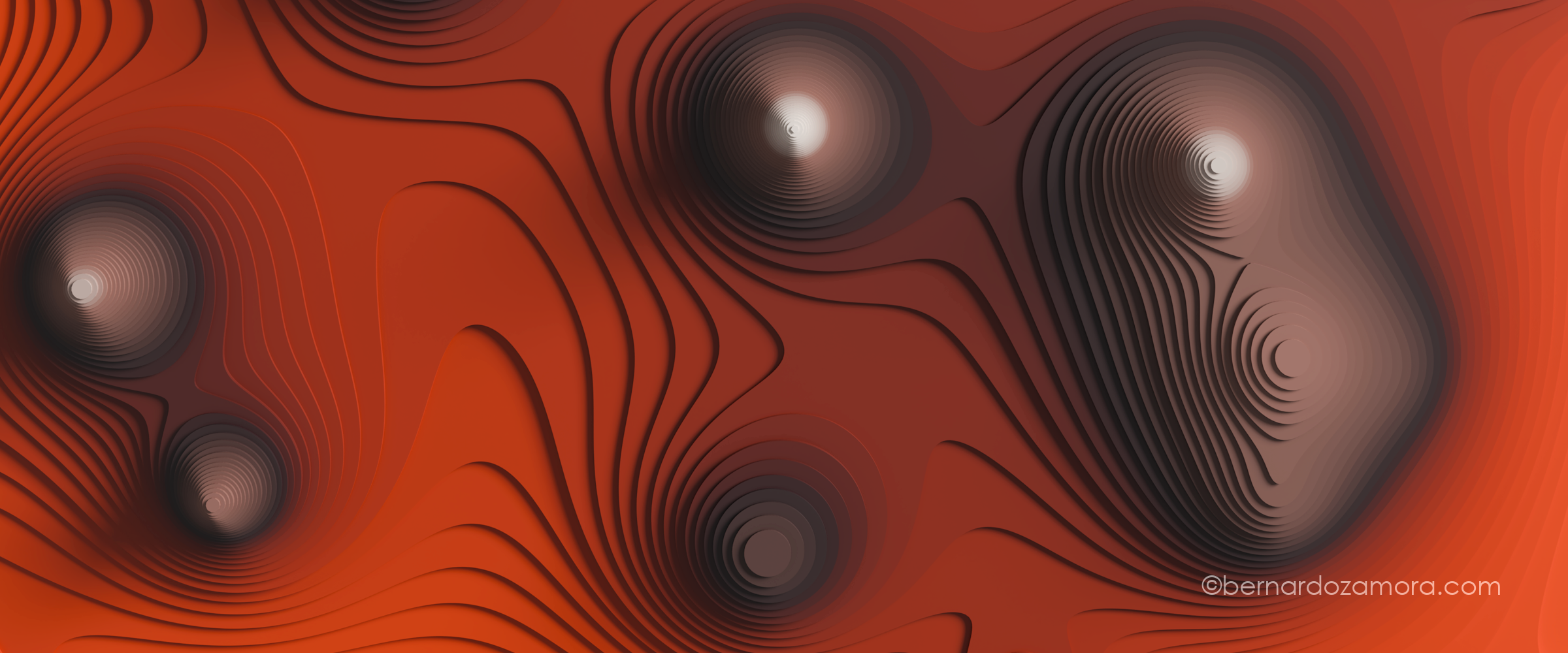
A stylized, top-down topographic map visualization of gravitational pull, rendered in a warm, terracota and deep ochre-orange palette. The landscape features deep, tiered concentric circular craters and elevated cones, defined by dark, layered shadow drop-offs. These concentric ring structures represent the gravitational wells of different planetary bodies, transitioning from deep, shadowy depressions into glowing, off-white central peaks.
Gravitational Fields: Equipotential Topography

Gravity twists space into invisible hills and valleys. This plate shows the gravitational pull around several planetary masses as 'heights', helping see the hidden geometry of planetary gravitational attraction.
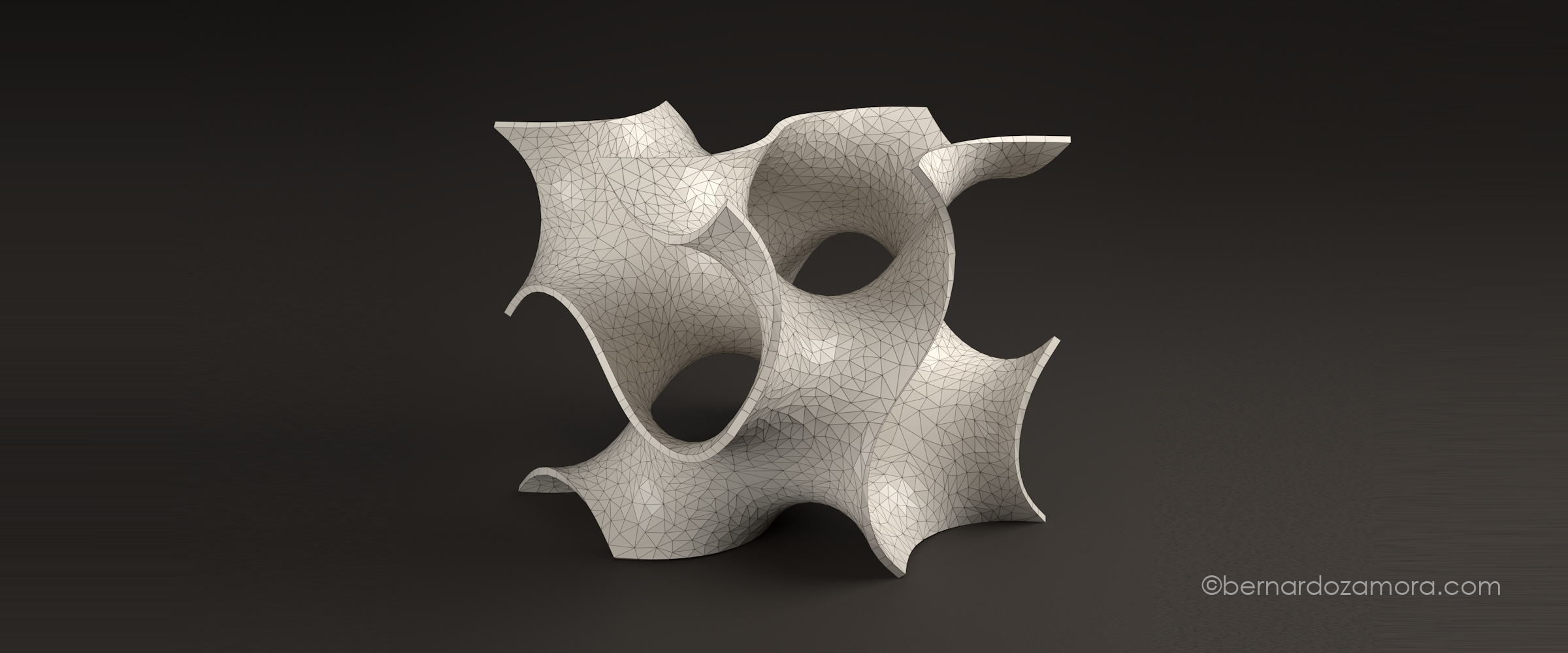
A 3D rendering of a single gyroid unit cell against a dark gradient background, showcasing its continuously curving, saddle-shaped surfaces and interlocking channels detailed with a fine, wireframe triangle mesh.
The Gyroid: A saddle of minimal surface

The gyroid is a triply periodic 'minimal surface' that twists without ever intersecting itself. It contains zero straight lines or flat planes, and every point on this shape forms a perfect saddle.
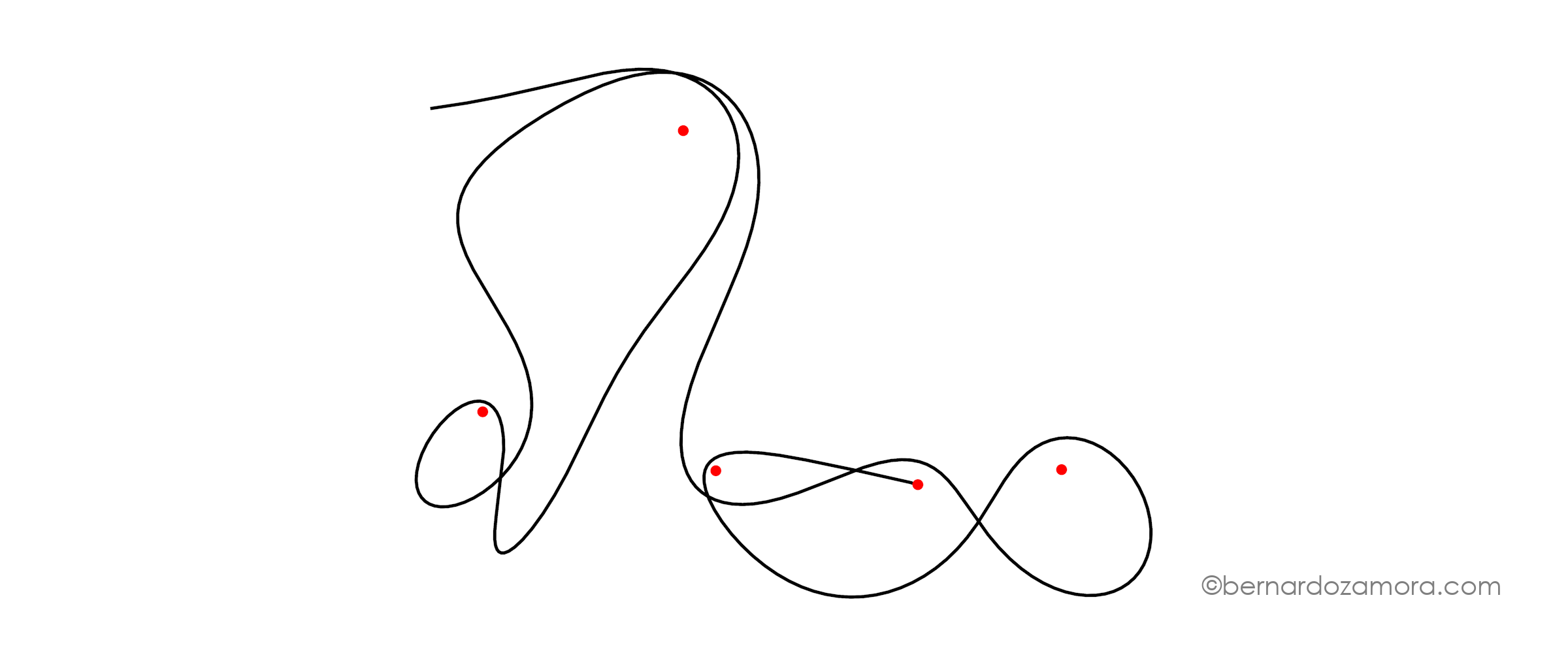
A minimalist vector art piece on a white background showing a continuous black trajectory line weaving chaotically around five small red dots representing planetary masses, evoking the silhouette of a person lying down and looking upward.
Gravity: Chaotic Paths

The path of an object attracted to several planets is highly chaotic. This plate illustrates the path an object takes before colliding with a planet, inadvertently creating the silhouette of a person lying down and looking up.
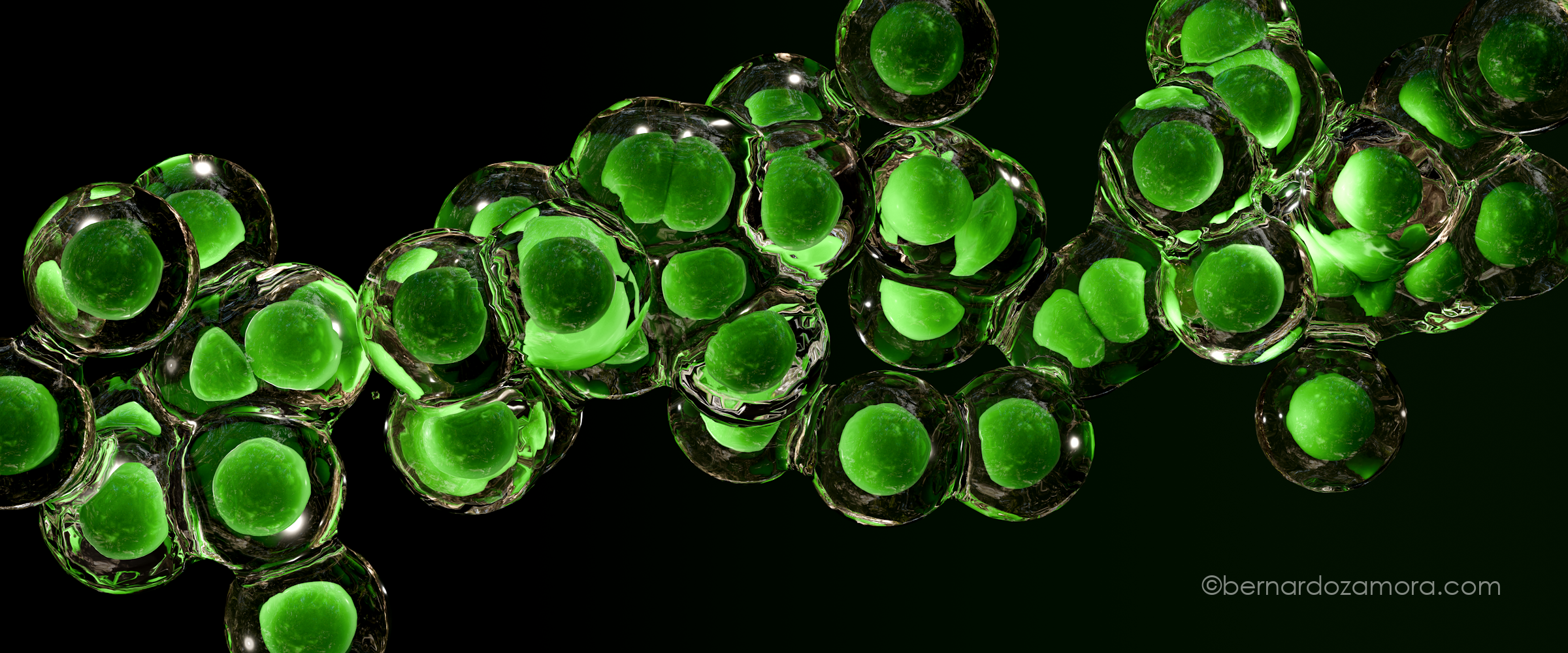
A 3D rendering of an organic cluster of cellular structures against a pitch-black background, consisting of transparent, glossy glass-like outer spheres that encapsulate glowing, vibrant green inner cores, resembling microscopic organisms or dividing biological cells.
Random: Complete Chaos

Purely random fluctuations are believed to govern quantum events. By assigning random values to position, scale, and surface displacement, and scattering them along a path, it manifests as a microscopic-looking cell.
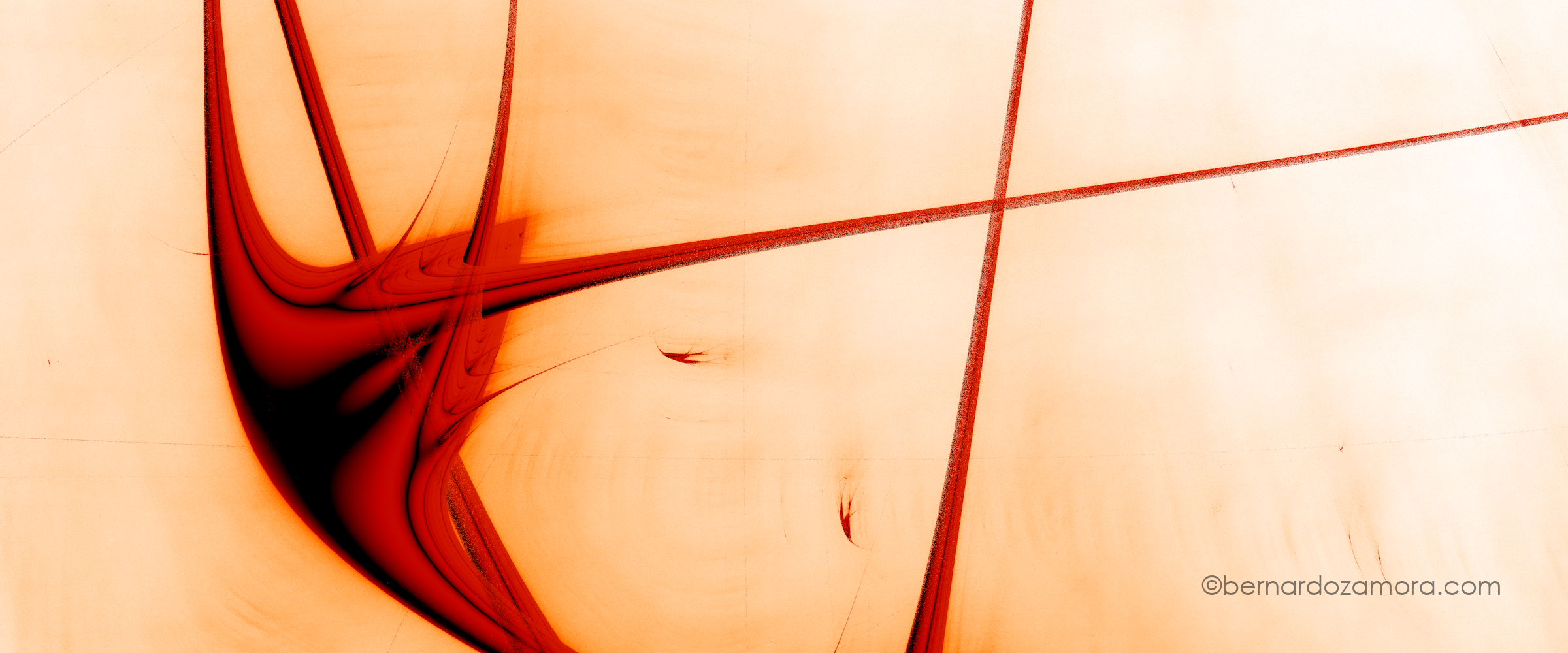
A high-resolution Lyapunov stability map of the Ikeda attractor set against a soft, pale orange background. The image features a prominent, swooping, crescent-like structure on the left rendered in deep, velvety crimson red and black.
Ikeda Attractor: Lyapunov Stability Map

Lyapunov diagrams map how chaotic and turbulent or stable is each region of a fractal. This plate showcases a section of the Lyapunov diagram for the Ikeda strange attractor.
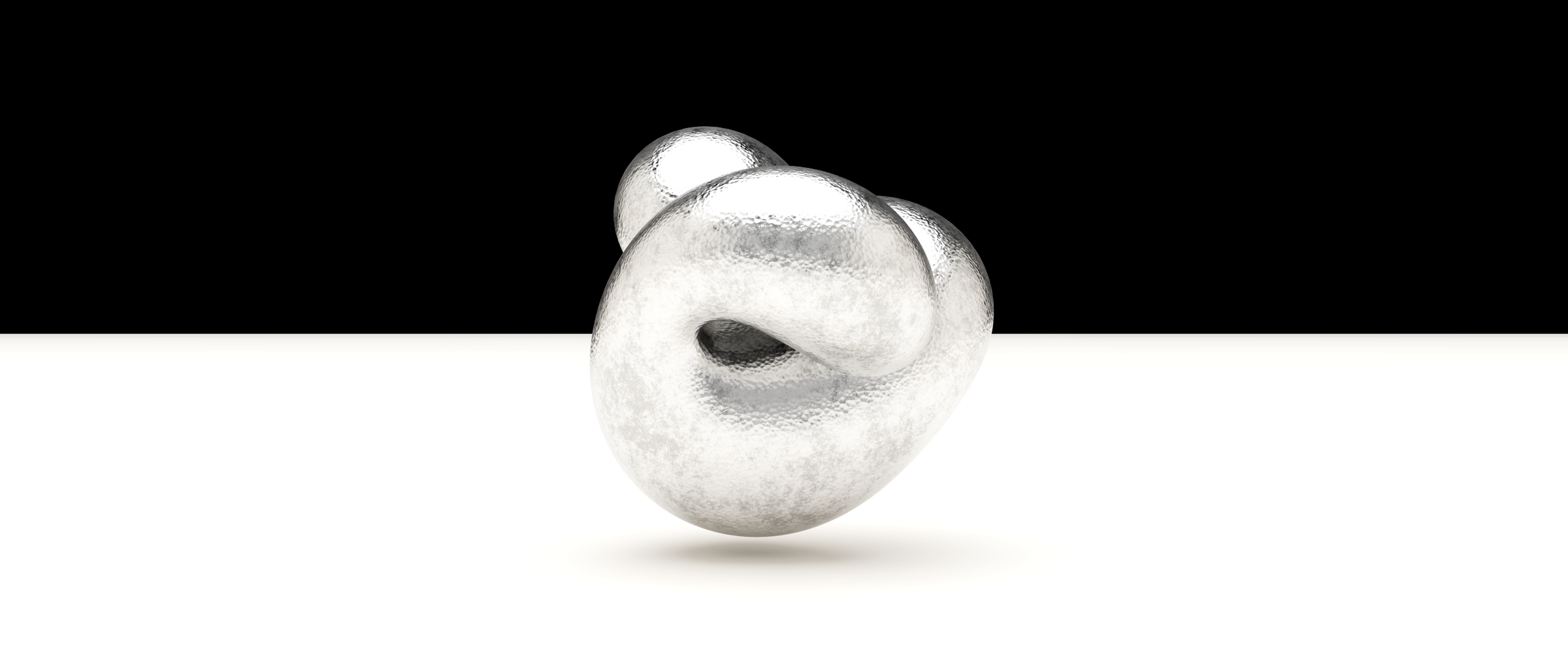
A smooth metallic 3D rendering of Boy's surface, a twisted self-intersecting shape from topology.
Boy's Surface: a non-orientable 3D shape

Boy's surface is a classic example of a non-orientable surface embedded in three dimensions, visualized here as hammered metal.
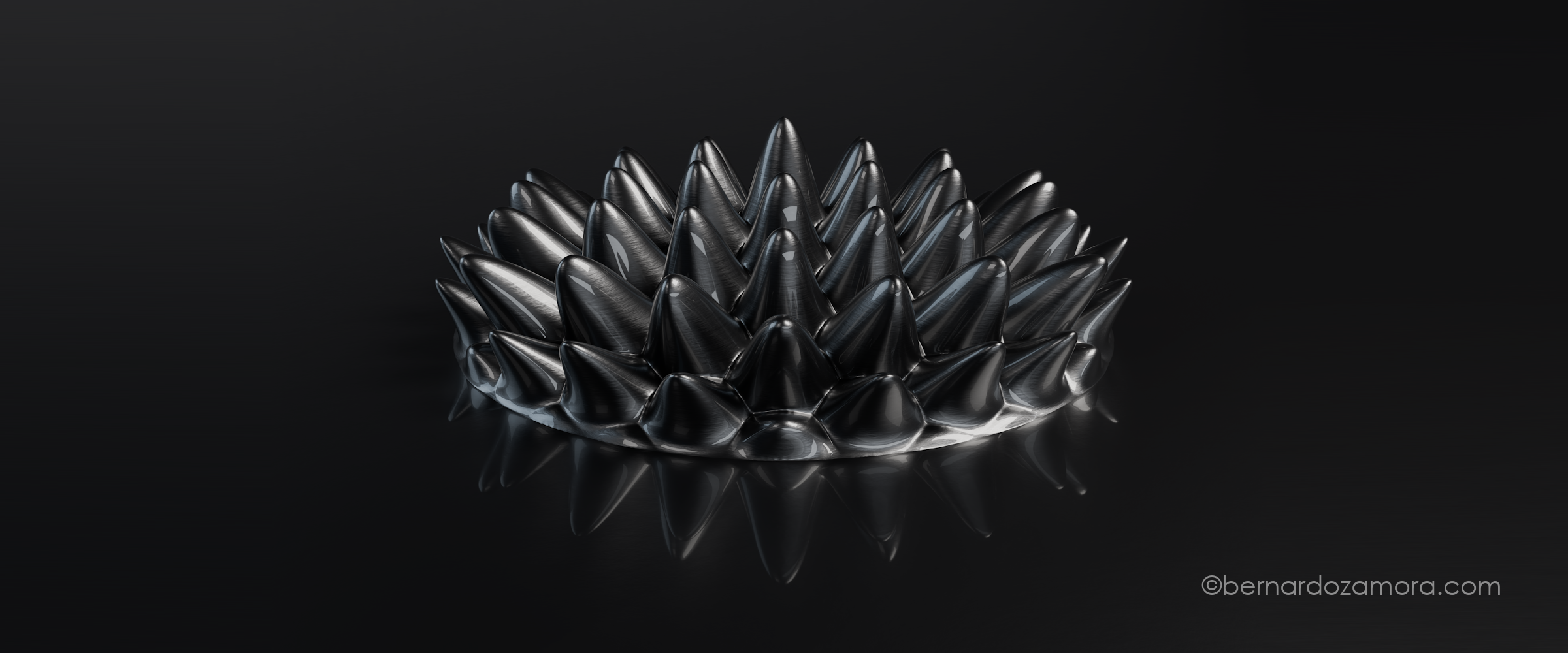
A computer render of a circular pool of black ferrofluid forming a cluster of sharp, uniform spikes due to a magnetic field, showing realistic metallic highlights and a soft reflection on a dark, glossy surface.
Ferrofluid: visualizing invisible magnetic fields

Ferrofluids are liquids packed with tiny magnetic particles. When exposed to a magnetic field, Ferrofluids undergo a 'Rosensweig instability,' which renders visible and otherwise invisible magnetic field.
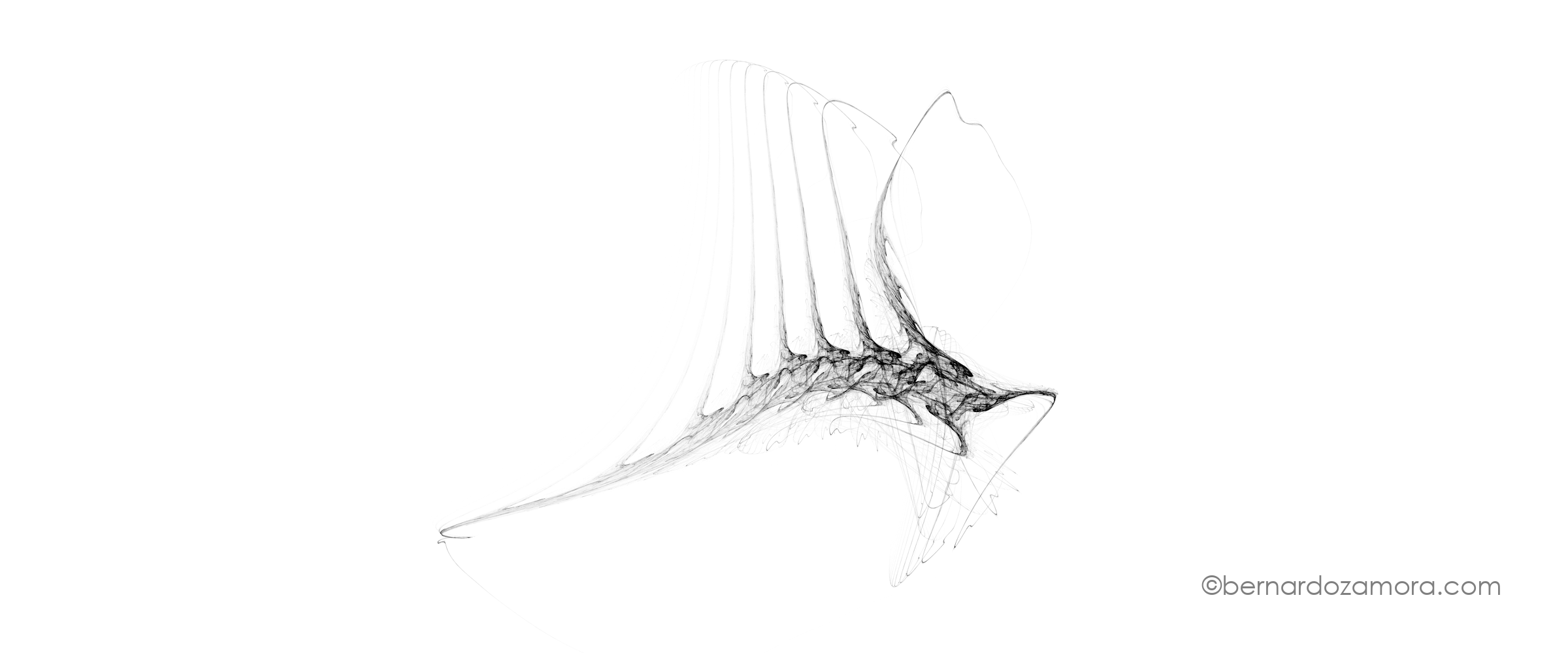
A delicate, abstract monochrome fractal generated via an Iterated Function System on a white background, featuring sweeping, skeletal curves and parallel vertical ridges that evoke the organic structure of a marine sailfin or prehistoric fossil.
Iterative Function System: repeatedly applying a function creates organic shapes

An Iterated Function System takes an initial point and repeatedly applies a function, plotting all intermediate points. After millions of iterations, we obtain highly complex organic-like structures.
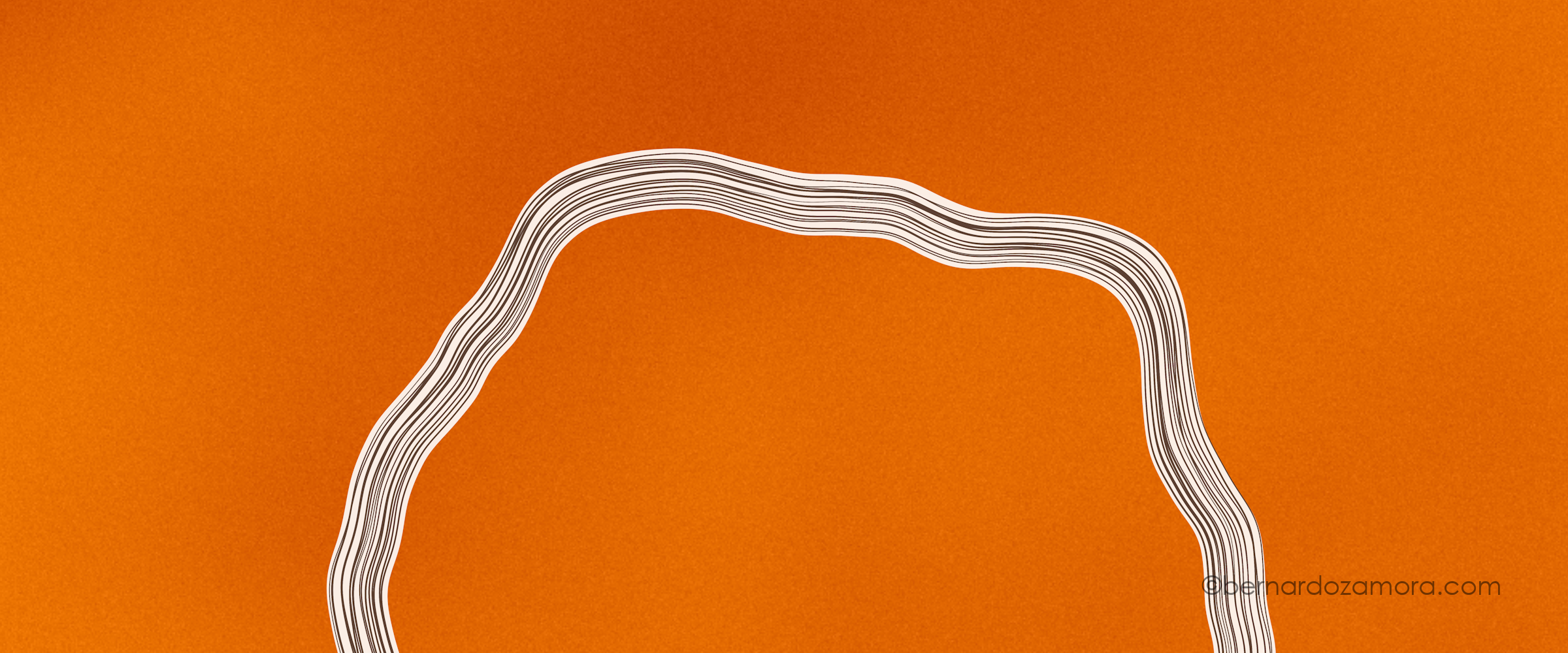
An abstract digital composition featuring a warm, finely grained ochre-orange background, interrupted at the bottom by a broad, undulating semi-circular band made of dozens of thin, parallel white and dark lines that ripple together like geological strata.
Fractional Brownian Motion: Ondulating patterns

This plate utilizes Fractional Brownian Motion (fBm), 'noise with memory', layering hundreds of distinct fBm values at varying scales and frequencies to generate the line patterns.
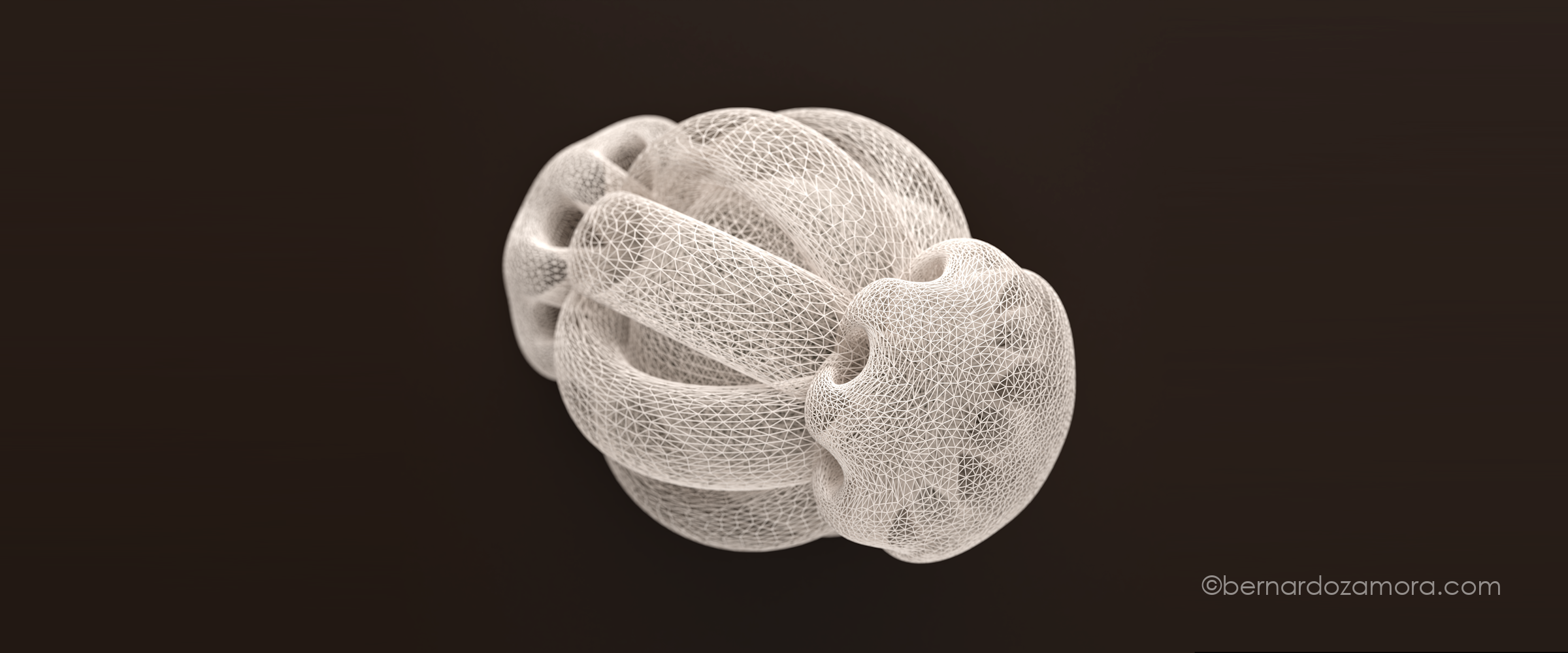
A 3D rendering of a mid-stage sphere eversion against a dark brown background, showcasing an intricate, multi-lobed geometric shape composed of an ivory-colored, semi-transparent triangular wireframe mesh.
Sphere Eversion: Turning a sphere inside-out without creases or breaks

In topology, a sphere can be turned inside out without tearing, puncturing, or sharp creases. This piece captures a snapshot of that geometric transformation, exposing the intricate self-intersections of the surface.
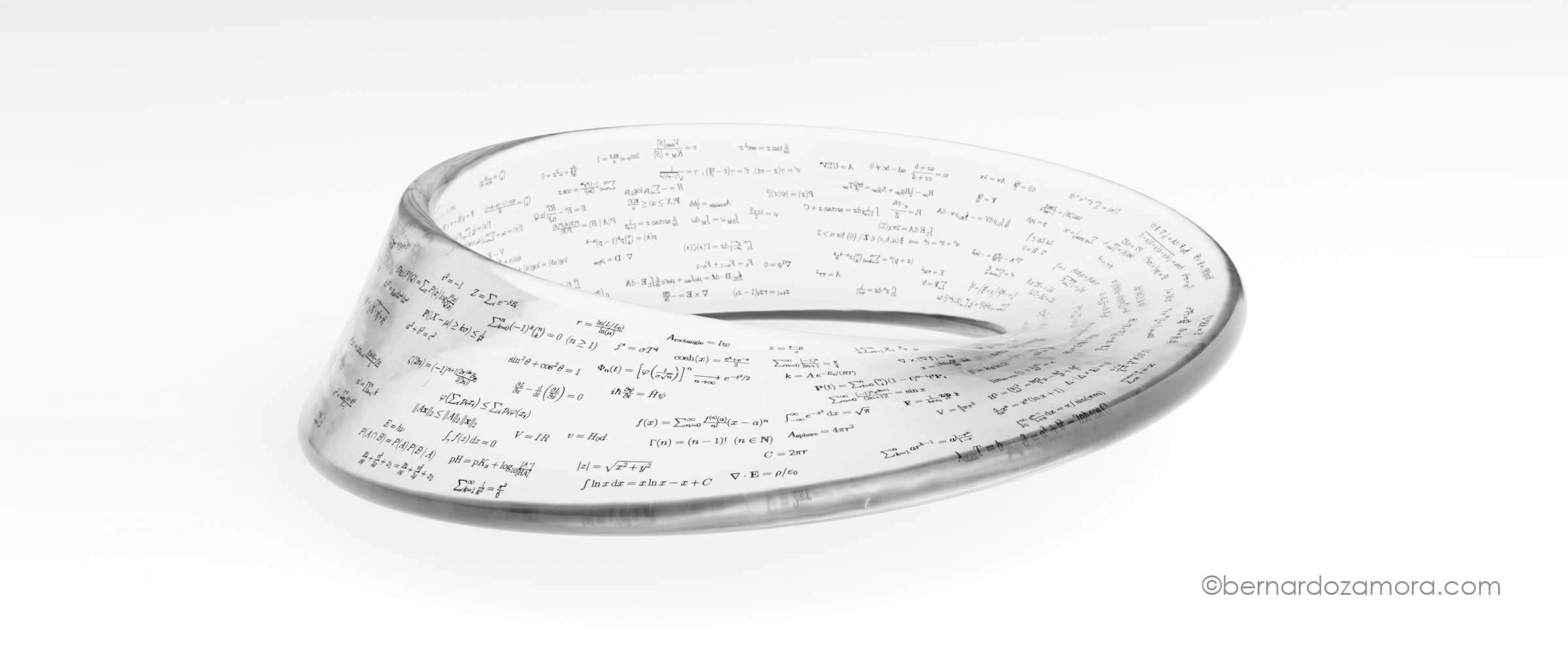
A 3D rendering of a thick, transparent glass Möbius strip resting on a clean white surface, forming a continuous one-sided loop with a single half twist, its surface etched with rows of black mathematical and scientific equations.
The Möbius Strip: A surface with only one side

A Möbius strip is a topological wonder created by giving a ribbon a single half-twist and joining the ends, resulting in a continuous surface with only one side and one edge. This plate highlights that endless geometry.
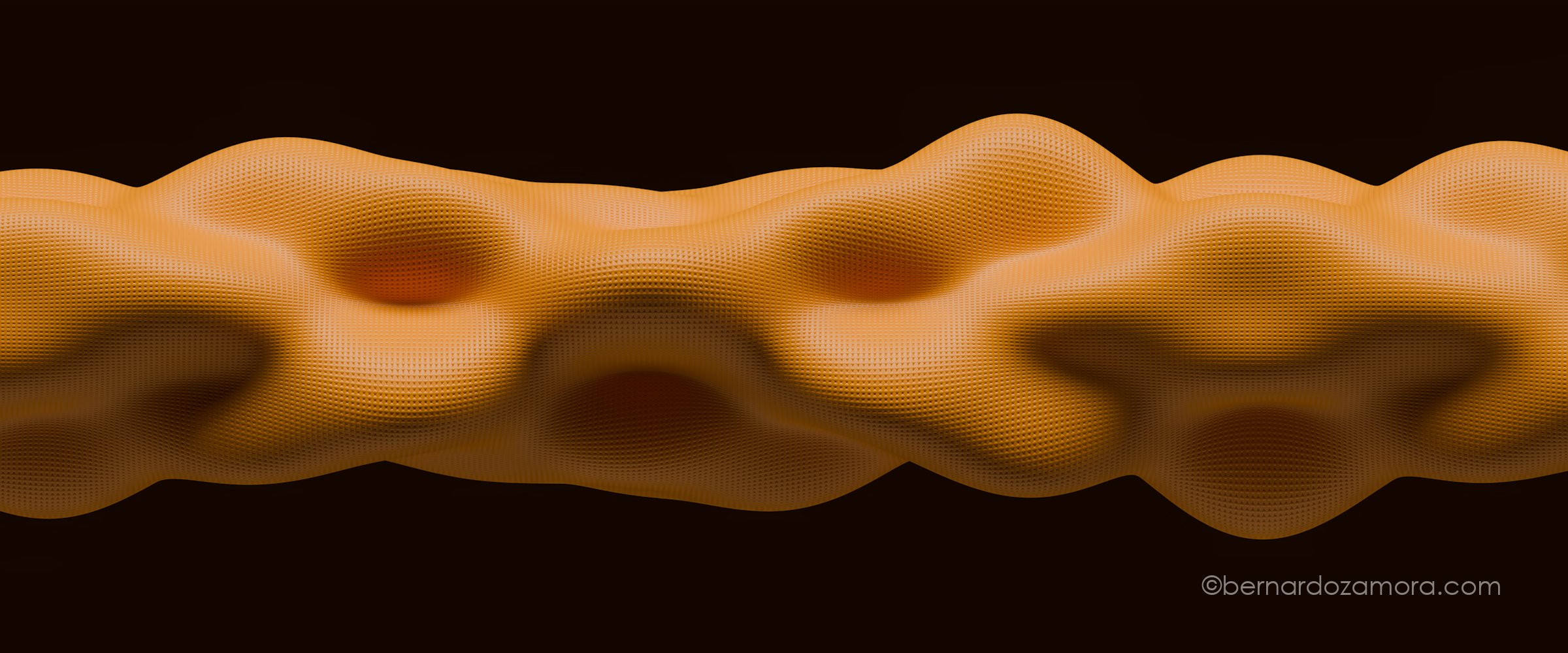
A horizontal, organic 3D structure resembling a textured ochre-orange tube rippling with uneven, bulbous waves against a dark background, its surface detailed with a fine, fabric-like grid mesh that deforms over the undulations.
Sound Waves: Moving Particles in a Medium

Sound travels as waves through a physical medium. This plate visualizes the wave interference created by sending two distinct frequencies from opposite ends of a cylindrical space.
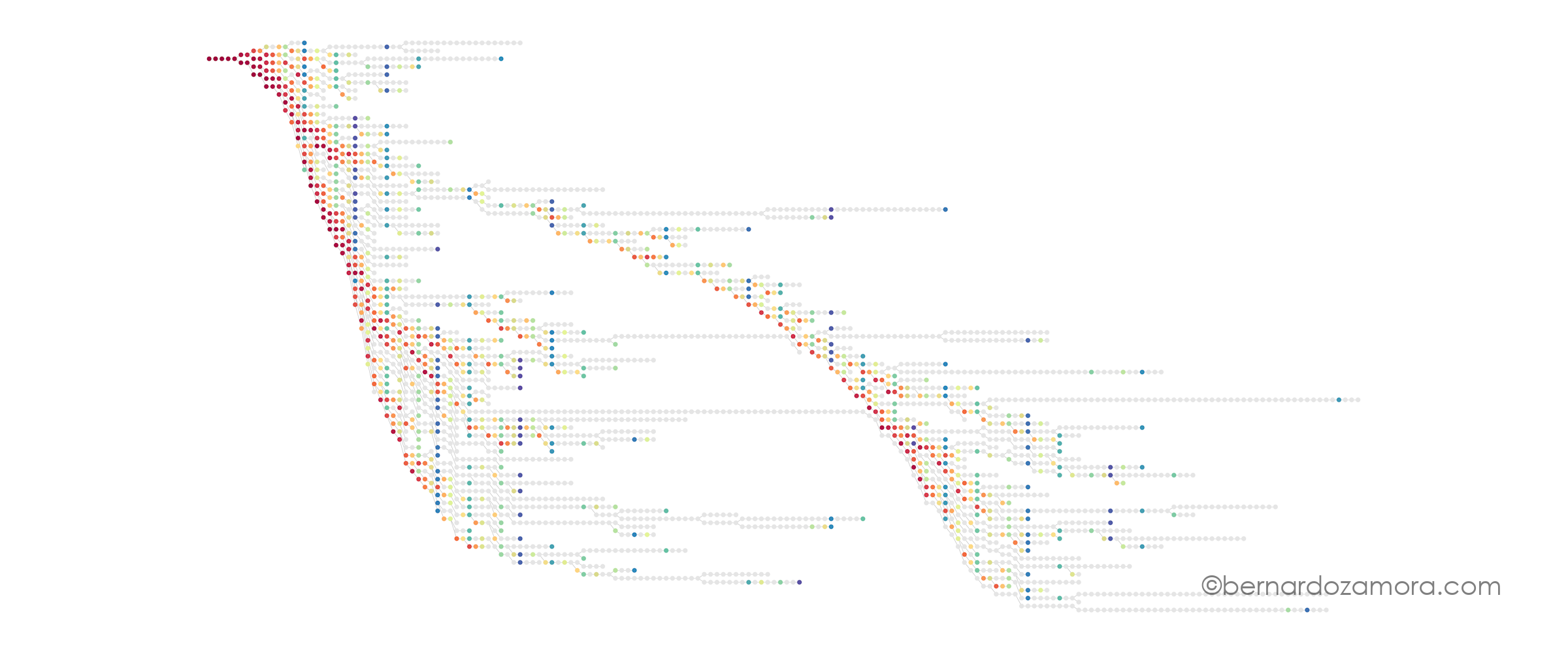
A directed graph visualization of the Collatz conjecture against a clean white background. The paths are constructed from small, densely arranged dots connected by light gray lines, forming a wide, branching tree structure that flows from left to right.
Collatz Conjecture: One of math's most famous unsolved problems

The Collatz conjecture states that taking any number and applying two specific formulas repeatedly will always result in the number 1. All numbers tested so far have ended up in 1. This plate shows numbers converging to 1.
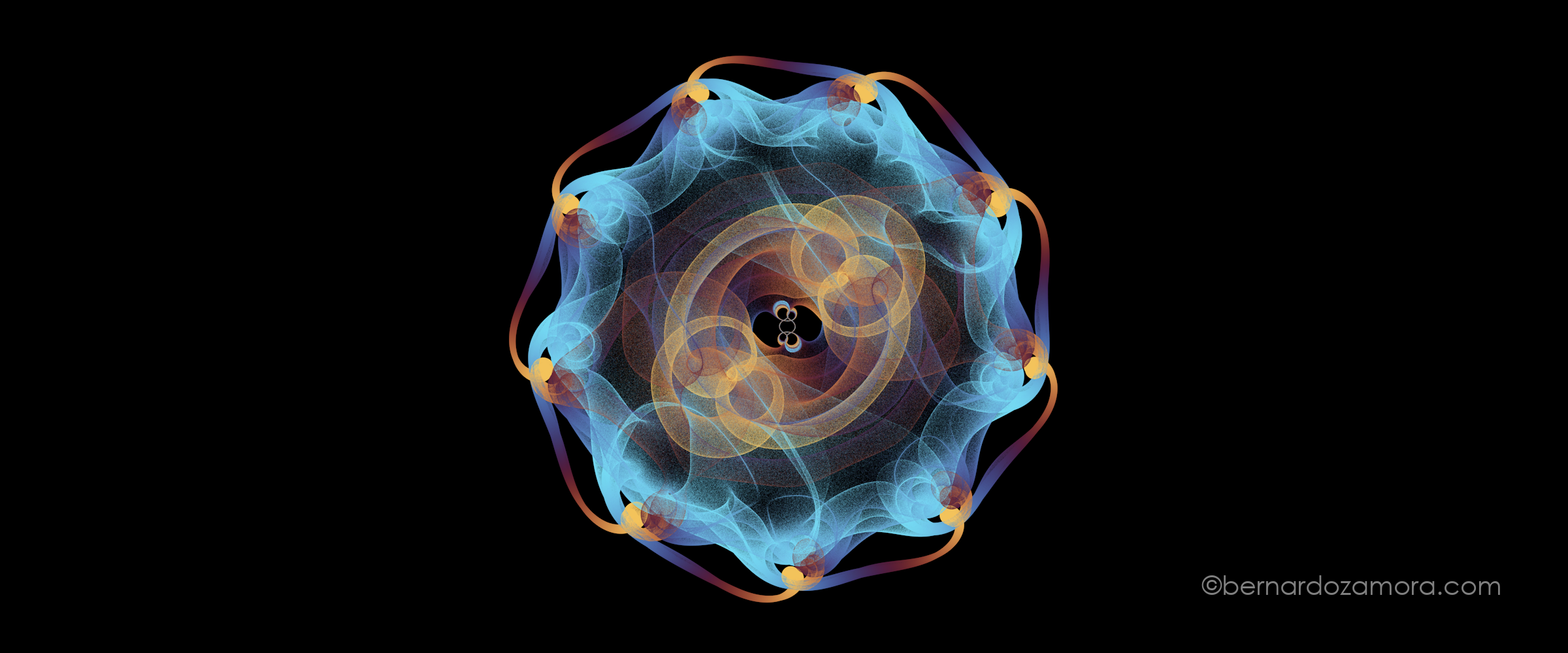
An intricate, highly symmetrical complex polynomial root plot on a black background, featuring an outer ring of eight glowing, translucent blue wispy structures connected by thin amber threads, surrounding an inner core of overlapping golden circular orbits and a dark center.
Polynomial Roots: zeroes of complex equations

A polynomial equation has as many roots (zeroes) as its highest degree. This plate maps the roots of an 8th-degree polynomial across millions of small variations, weaving them into a striking, multi-colored tapestry.
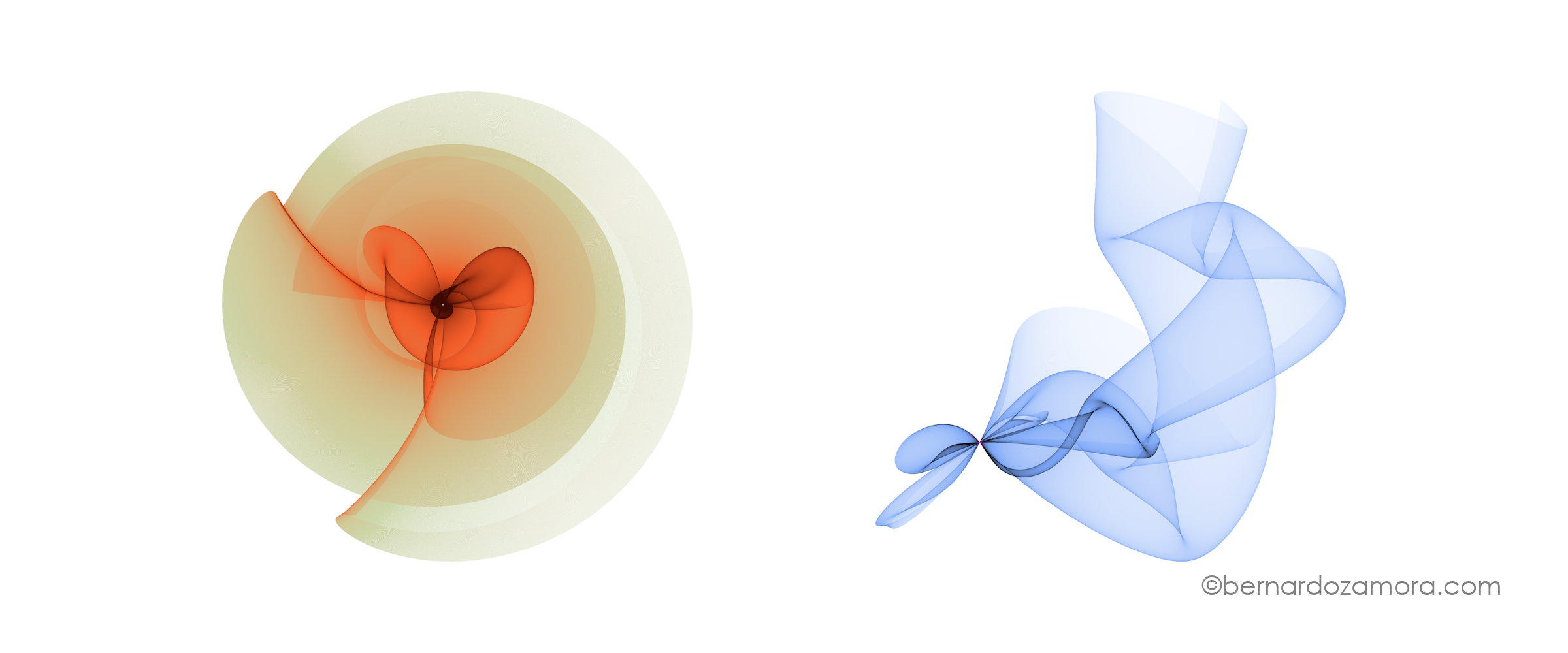
An abstract mathematical density plot showing two images: one with rich rich orange, tri-lobed floral or propeller shape at the center, another a soft transparent blue 'cloth', both over white background.
Coordinate Transformations: Mathematical Folding

Just as a star's massive gravity warps the fabric of space to bend light, these images rely on a similar mathematical logic. They take a flat plane of 200 million points and warp them through two equations.
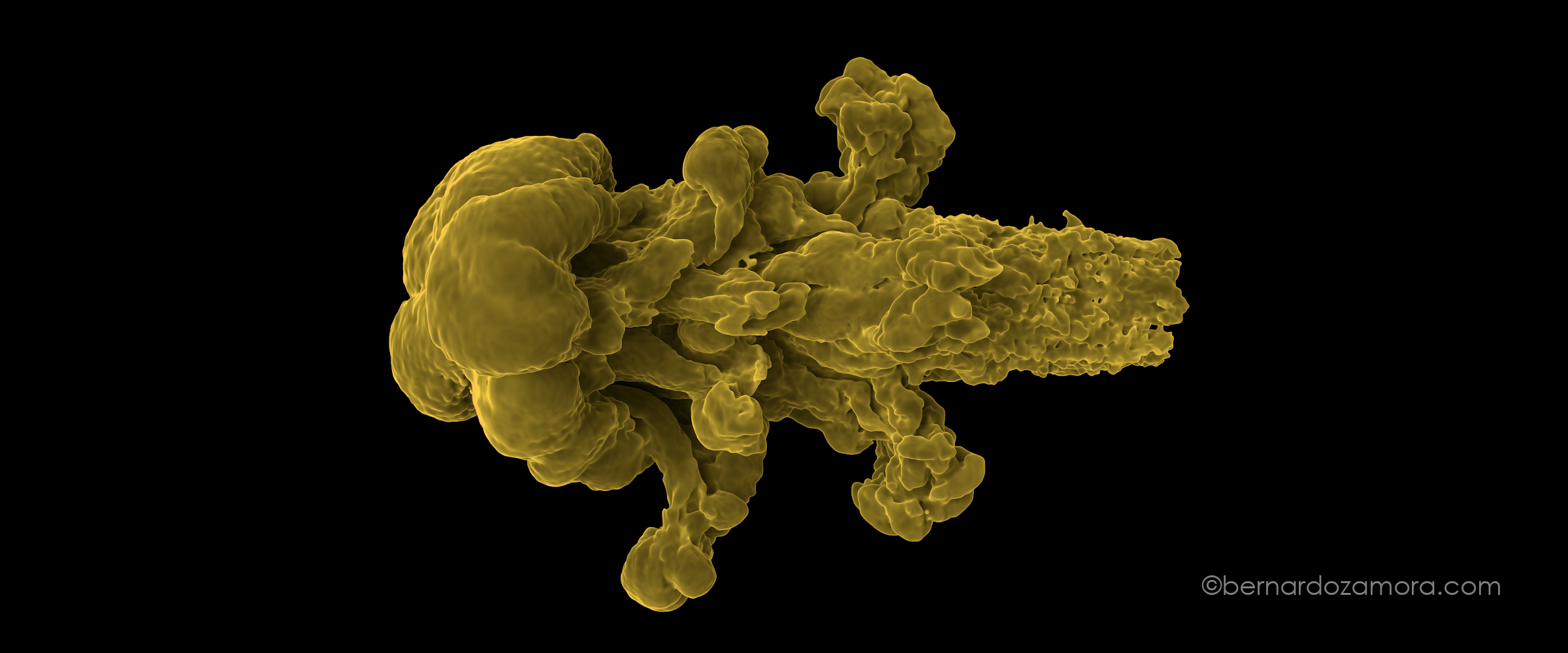
A highly detailed 3D fluid simulation of a dense plume of smoke rendered in a solid, monochromatic ochre-yellow hue against a pitch-black background. The smoke erupts horizontally from a textured trailing stream on the right, expanding into turbulent, billowing, cloud-like structures with deep crevices and complex organic folds as it moves to the left.
Navier-Stokes: Simulating Smoke

The complex, turbulent curls of rising smoke are explained by the Navier-Stokes equations. These are the foundational laws of fluid dynamics. This plate is the result of simulating several seconds of gas flow.
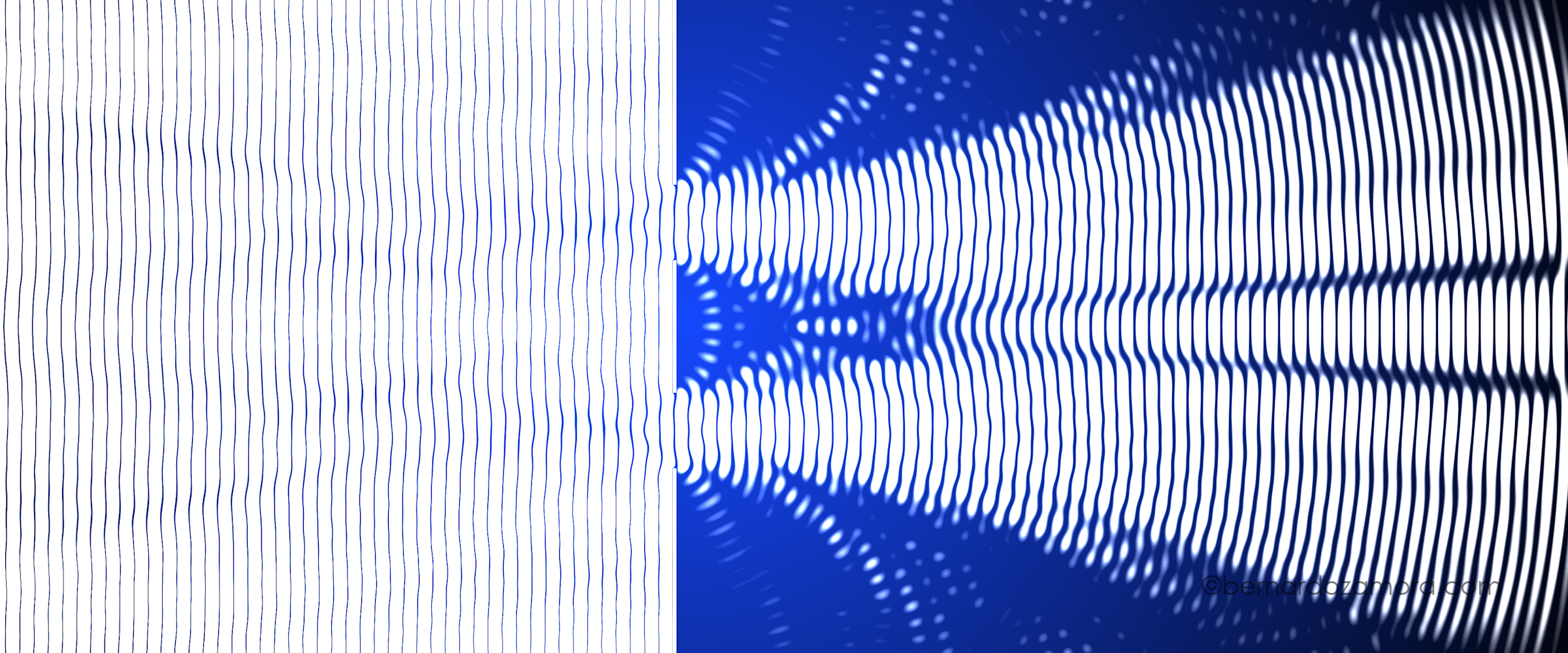
A simulation of the double-slit experiment split into two halves. On the left, fine blue parallel vertical lines move across a plain white background, representing incoming plane waves. On the right, after passing through two central slits, the waves emerge into a deep blue field as concentric, overlapping ripples, creating a stark white interference pattern of alternating bright fringes and dark gaps.
The Double-Slit Experiment: Particle or Wave?

The double-slit experiment shows that particles behave like a wave, creating overlapping ripples of interference. The moment a particle is watched, the wave collapses and it acts like a solid object.
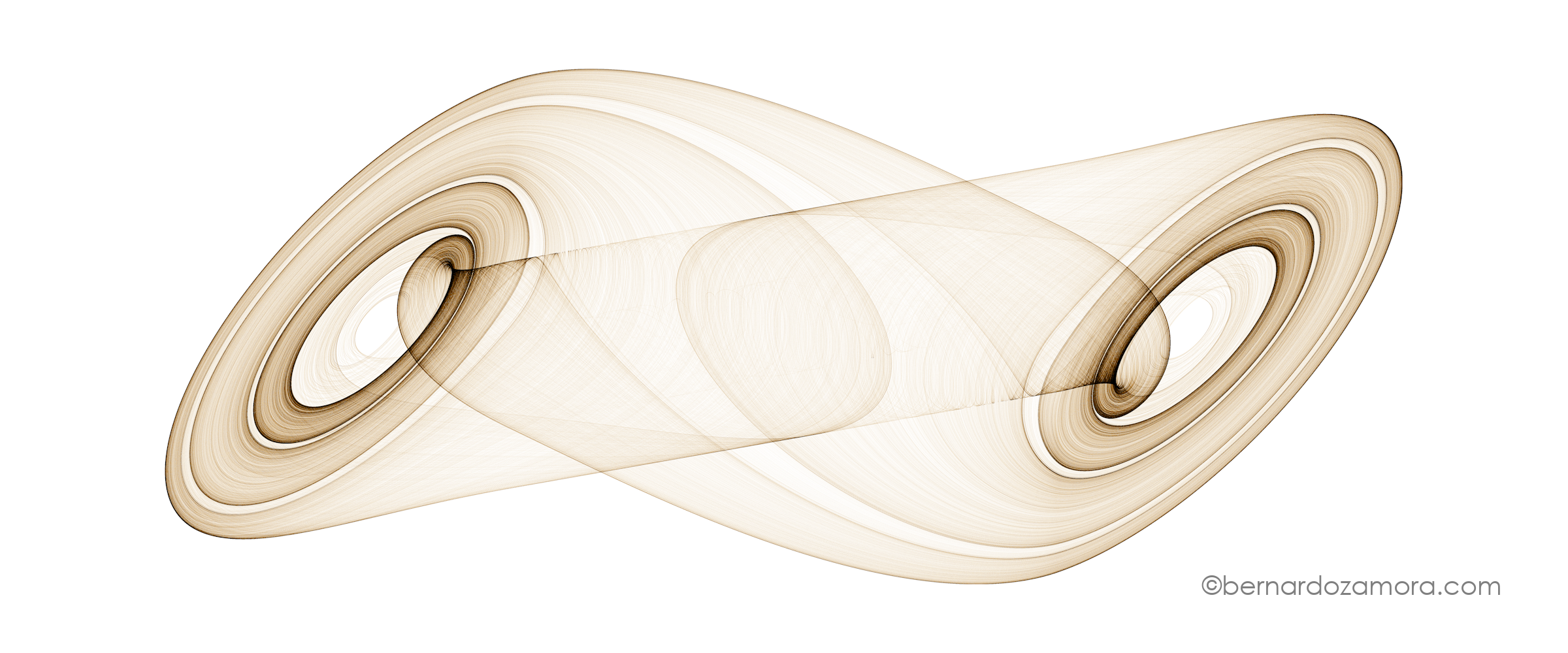
A high-resolution line drawing of Chua's circuit double scroll attractor against a pure white background. The continuous trajectory is rendered in a dark reddish-brown hue, composed of thousands of overlapping, delicate lines that trace out an asymmetrical infinity or butterfly shape. The path tightly spirals around two distinct, dark focal points on the left and right, forming layered, translucent bands that elegantly cross over one another in the center.
Chua's Circuit: Simplest Strange Attractor

Chua’s circuit is a simple electronic system with chaotic behavior. Three equations describe the oscillating electrical signal loops, creating a double scroll attractor, winding but never repeating its path.
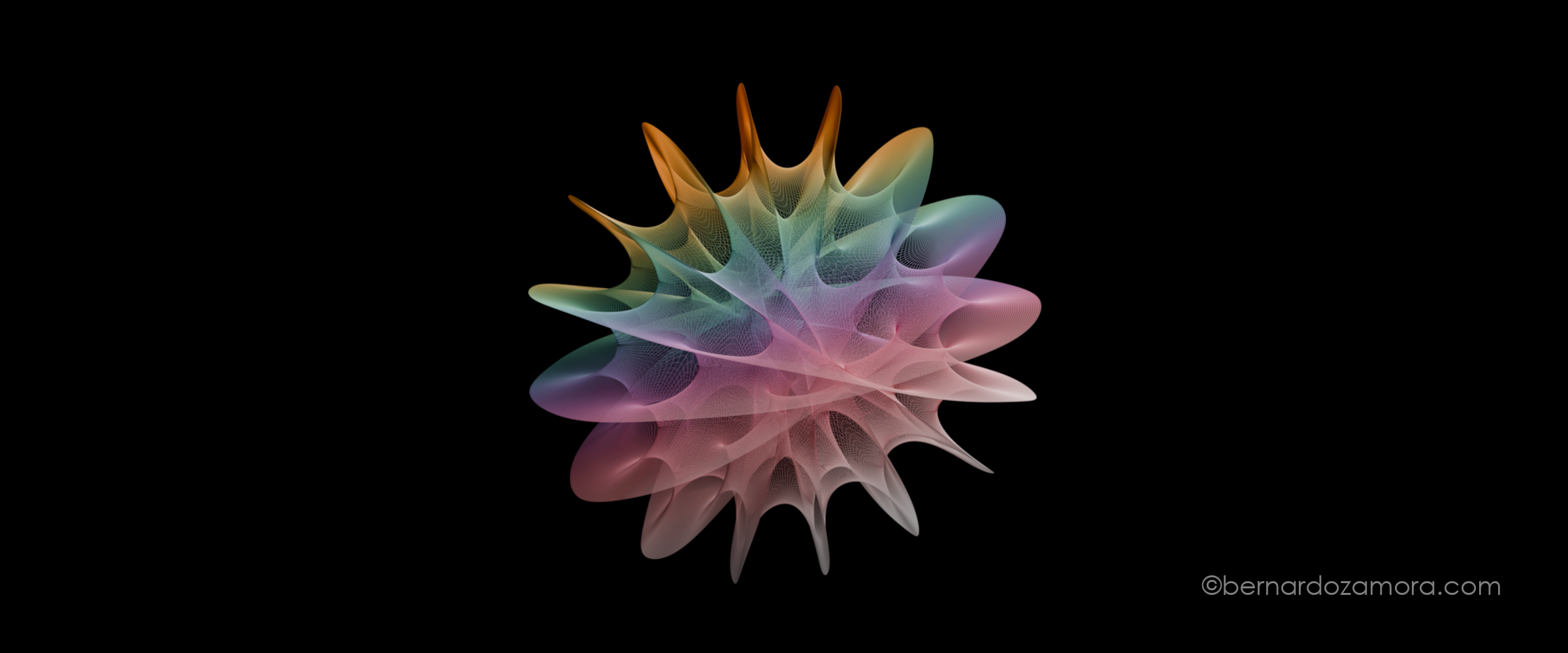
A mathematical 3D projection of an eight-dimensional Calabi-Yau manifold against a black background. The structure forms a complex, multi-lobed starburst shape with translucent, tightly woven wireframe lines that shift in a smooth rainbow gradient from orange and green on the left to violet and soft pink on the right.
Calabi-Yau Manifold: Shadows of a Higher-Dimension

String theory states that the building blocks of the universe are tiny, vibrating strings, with six dimensions, represented by Calabi-Yau manifolds. This image visualizes a shadow of an 8-dimension structure.
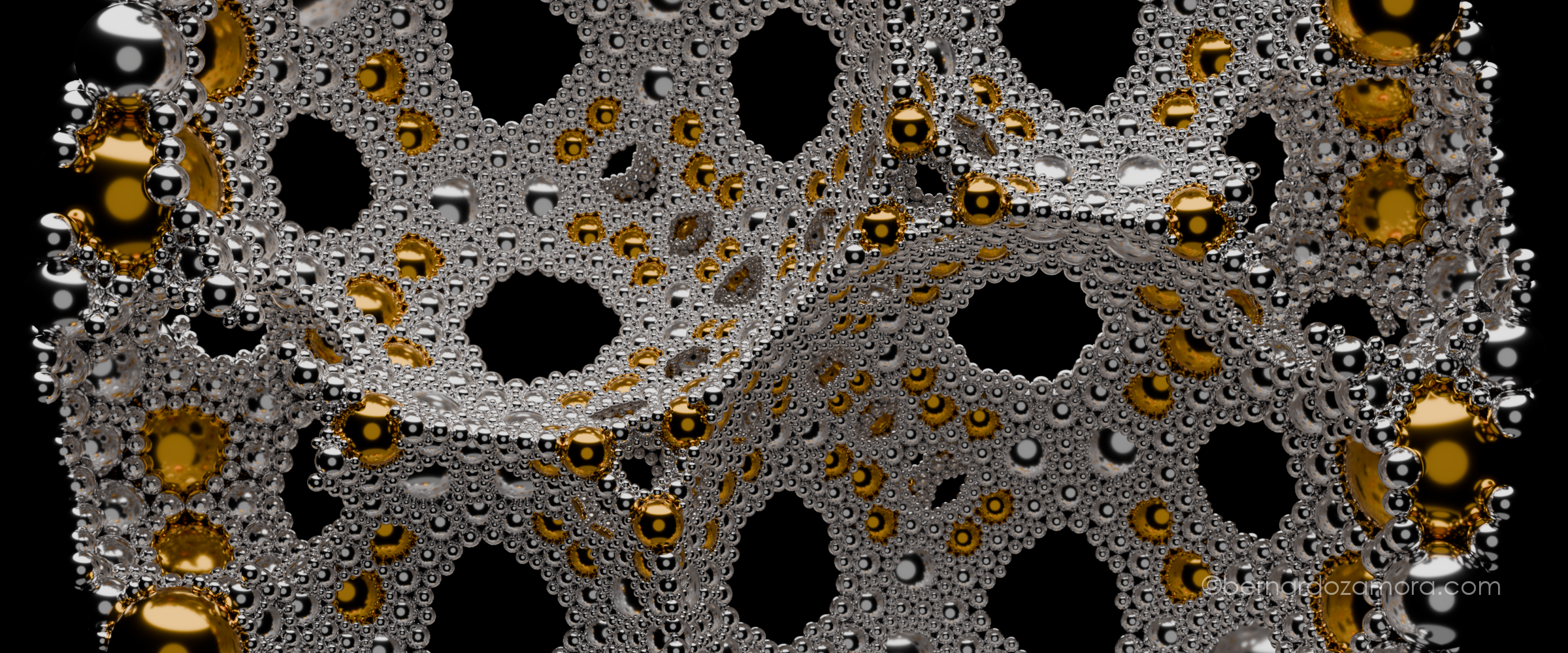
A macro render of a 3D Apollonian sphere packing against a dark background. Thousands of highly reflective chrome spheres form an intricate, porous lattice structure with hollow circular gaps. Interspersed within the silvery matrix are larger, metallic gold spheres nestled inside select gaps, casting crisp reflections on the neighboring metallic surfaces.
Apollonian Sphere Packing: infinite fill

Take a hollow sphere, place 4 smaller spheres inside touching each other and the outer shell. Keep adding ever smaller spheres in every empty space. This plate shows the resulting intricate geometry.